Skip to content

Posts tagged ‘Bashar al-Assad’

5 Reasons Why the Obama Administration’s Decision to Offer “Military Support” to Syrian Rebels Couldn’t Come at a Worse Time

By Sara Bjerg Moller

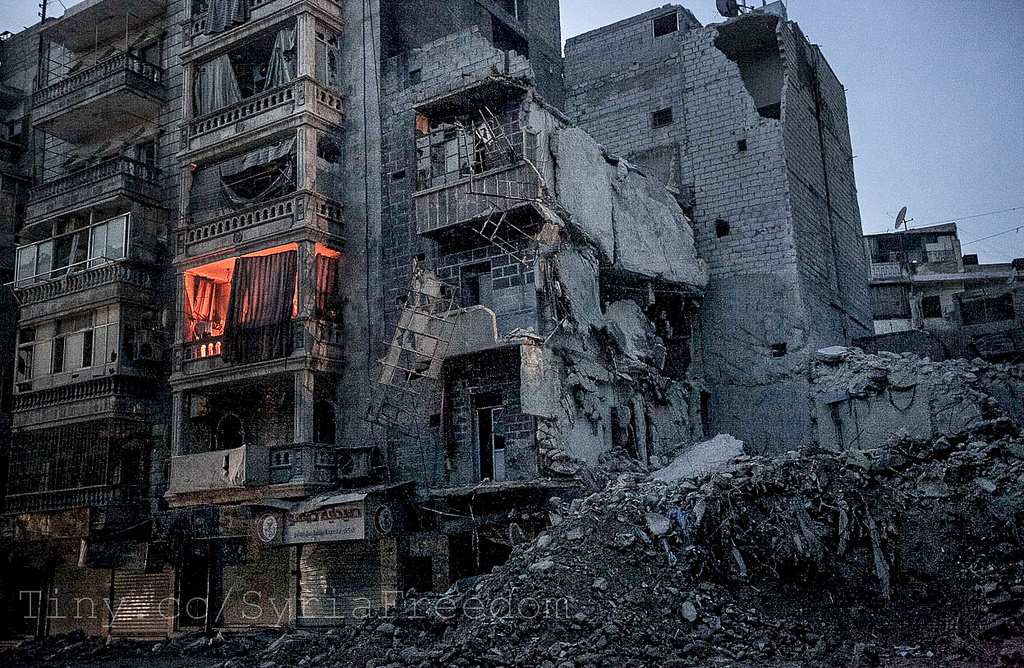
December 2012 AP photo by Narciso Contreras, via Freedom House.

December 2012 AP photo by Narciso Contreras, via Freedom House.

Yesterday’s surprise announcement by the White House that the US will “increase the scale and scope of assistance” to Syrian rebels comes at the worst possible time. Here’s why:

1.)  Too Little/Too Late: Washington’s window of opportunity to alter the course of events in Syria has already come and gone. In fact, America’s ability to influence events on the ground in Syria is probably the lowest it has been since the conflict began. Even on the rare off-chance that the kind of military support the administration is thinking about tips the scale in favor of the rebels, Syrians (and the wider Arab world) are unlikely to thank us. Two years and 93,000 deaths into the conflict, many Syrians will instead resent the fact that it took Washington this long to act. By contrast, a rebel victory would see the Qataris and Saudis praised for their early support. In short, the US will get all of the blame and none of the credit.

2.)  What Red Line? Even putting aside for a moment all of the problems associated with the use of publicly pronounced red lines (and there are many,) the administration’s claim that it is responding to the Assad regime’s violation of Obama’s December 2012 prohibition on the use of chemical weapons is flimsy at best.

The timing is odd and makes the US look indecisive. The Israelis announced back on April 23 they had proof the Syrian military had used chemical weapons. Even before the Israelis went public, however, the British and the French had already provided the UN with their own evidence in the form of soil samples. Obviously the US government had to evaluate the evidence itself before acting, but this is a process that typically takes days or weeks not months.

In fact, our own intelligence community concluded in late April that the Syrians had most likely used sarin nerve gas. Announcing what amounts to a major policy shift in mid-June while justifying the decision on the basis of activity that took place as far back as last year and has been public knowledge since at least April doesn’t quite add up. (Unless of course US officials never considered the possibility that deterrence might fail and had no strategy for dealing with such an eventuality; itself deeply troubling if true.)

Nevertheless, the White House’s assertion that it is intervening now because of Syria’s traversing of the red line is unlikely to convince anybody. Rather than redeem American credibility, the lesson other states are likely to draw is that (at least in the short term) they can get away with crossing well-established red lines while the US government conducts a multi-month internal policy debate on what to do next.

3.)  Escalation. Paradoxically, and tragically, the US decision may actually lead to increased violence in Syria rather than halt the killings. This is because the US about-face comes in the wake of the conflict having already drawn in a number of other actors. If the US was going to intervene at all the best time to do so would have been before regional actors like Hezbollah got involved. Coming in the wake of a more crowded and increasingly sectarianized field, Washington’s room to maneuver is likely to be significantly reduced from what it once could have been. Hezbollah in particular will be emboldened by the news and will probably step up its involvement in the conflict, making any US exit down the road more difficult.

4.)  Kiss Geneva Goodbye. Although the probability that Geneva II would produce a diplomatic solution was never high to begin with, Washington’s announcement yesterday has eroded what little possibility there was of securing an immediate cessation to the fighting. The Obama administration has not only rendered next month’s summit unnecessary, it has effectively put an end to what may have been the last best hope for the international community to stop the violence any time soon. If Washington’s primary aim is to stop the killing then even a temporary respite from the fighting would have been better than a continuation of the war, let alone the escalation that is now sure to follow.

5.)  Schizophrenic US Foreign Policy. The sudden reversal by the administration is bound to leave our allies and enemies scratching their heads. For an administration that has prided itself on its handling of foreign policy yesterday’s policy shift stands in marked contrast to previous successes. And, at least domestically, the announcement will play right into the very narrative the Obama administration spent all last week trying to dispel; namely that the appointments of Susan Rice and Samantha Power as National Security Advisor and Ambassador to the UN mark an interventionist turn in US foreign policy.

In sum, even those who advocated for greater US involvement in Syria over the past year and are happy to see the Obama administration now doing so should be concerned by the timing and manner in which this policy decision has come about.

R2P ≠ Regime Change

By Andrew Kydd

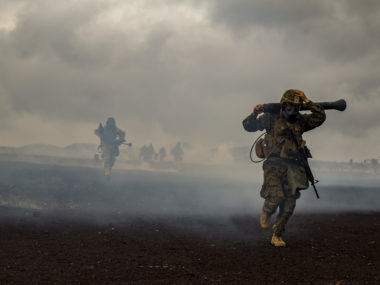
USAF photo by Staff Sgt. Lee F. Corkran, via (a href="http://commons.wikimedia.org/wiki/File:Mark-84_bomb.jpg">Wikimedia.

USAF photo by Staff Sgt. Lee F. Corkran, via Wikimedia.

We are now past at least 70,000 dead in the Syrian conflict and mass atrocities are being committed on an almost daily basis. The Syrian government has mobilized thugs who appear to lack any military discipline or accountability. Yet Washington takes notice not of real massacres committed with ordinary weapons, but of marginal uses of chemical weapons that have killed comparatively few. Washington inches towards military support of the rebels as if this is the appropriate next step, like a medieval doctor who grimly decides the time has come to put leeches on the arms as well as the legs of a dying patient. Meanwhile, we are treated to the absurd suggestion that we should invade Syria and reconstruct the state in order to intimidate Iran into giving up its nuclear program, which calls to mind Einstein’s definition of insanity, doing the same thing over and over and expecting different results.

Part of the problem is that Washington equates intervention with regime change. In Libya, UN approval for an intervention to protect civilians was used as a license to overthrow Qadaffi. To outward appearances, there was no serious reflection in the administration about this, and no one arguing that this was a mistake. This stands in marked contrast to two previous cases. First, under George H. W. Bush, the US scrupulously observed the international mandate to evict Iraq from Kuwait, but did not go on to overthrow Saddam Hussein. Neo-conservatives then began the long march to 2003, when this restraint would be abandoned, with results that are plain to see. Second, in the Kosovo case in 1999, NATO conducted, without UN permission, an air campaign to evict Serbian forces from Kosovo. The campaign ended before Milosevic was overthrown, although it did decide the issue in favor of the separatist rebels. But in neither case was intervention equated with regime change. We seem to have lost sight of this possibility, in particular, we are unable to envision any form of intervention that would protect civilians in a civil war that does not involve supporting the rebel forces. This is an enormous failure of imagination on the part of US policymakers. As we fail to come up with effective policy options, tens of thousands of Syrians are dying and the future of Syria as a unified country is increasingly cast into doubt.

Let’s therefore unbundle the protection of civilians from regime change, total victory, boots on the ground, and other things that do not necessarily go together. In particular, let’s remind ourselves of the Dayton agreement that ended the Bosnian war. In that case, airpower was brought to bear against Serbia, but not to the point of total victory for the Bosnian Muslims and Croats. Instead, it was used to convince the Serbs that total victory was beyond them, and to facilitate the creation of a front line that would be the basis for subsequent negotiations. Those negotiations then became the focus, and neither side got what they wanted. However, the killing stopped. The resulting state of affairs can hardly be called a unitary state, and it might have been just as well to arrange an outright partition. And yet, thousands of people are alive today who would be dead if the US had not acted as it did. Despite the counsel of the critics of “liberal interventionism”, that counts for something.

Political Violence Thought of the Week

By Erica Chenoweth

A regime aircraft over Maraat al-Numan, November 2012. Photo via John Cantlie/AFP/Getty Images, via Freedom House.

A regime aircraft over Maraat al-Numan, November 2012. Photo via John Cantlie/AFP/Getty Images, via Freedom House.

A recent article in the New York Times reminded me of recent work about why violence against civilians is so ineffective.

Referring to the shelling of several Lebanese towns near the Syrian border, Anne Barnard & colleagues document several responses by the Lebanese population:

“Residents said they believed that they were being targeted because Hezbollah, the pro-Syrian Lebanese Shiite militant group, is the political power in the village and bases some operations nearby. But Saad Hamedeh, the son of Hermel’s tribal sheik, said there were no military targets in the village. ‘They are trying to kill civilians,’ he said.”

This last line reminded me of Max Abrahms’ recent work, which focuses on how cognitive biases affect perceptions of violence against civilians. Armed actors generally target civilians for four main reasons: (1) to punish civilians for supporting their opponents (2) to deter them from doing so in the future; (3) to send a costly signal to a broader audience that the group is resolved and capable of inflicting maximum political damage; or (4) by accident or incompetence.

Regardless of whether the civilian targets are the victims of “costly signals,” punishment, or accident, Abrahms finds that the targets themselves often make their own, independent inferences about the armed groups’ motives. Importantly, when armed groups target civilians, the civilian population often understands these motives as simply murderous and senseless. Instead of understanding the violence to be politically instrumental, so to speak, they interpret the violence as “They want to kill us.” They see the violence as an end in itself.

To explain this phenomenon, Abrahms references a cognitive process called attribution error, where the object infers the subject’s motives based on the subject’s observed behavior rather than her stated and/or true intentions.

This is why violence against civilians, as opposed to violence against other armed combatants, has such a low success rate. It’s one thing to submit to rebels. It’s quite another thing to submit to people you see as “murderers.”

On the Perils of Red Lines

By Erica Chenoweth

Barack Obama meets with his national security team. Official White House Photo by Pete Souza.

Barack Obama meets with his national security team. Official White House photo by Pete Souza.

  • Our very own contributor Dan Byman has an op-ed in the Sunday New York Times arguing that Obama shouldn’t draw red lines. His article assumes that Obama meant to draw the red line at chemical weapons use, which seems dubious now that…
  • The selfsame edition of the Times has printed a front-page piece suggesting that Obama didn’t really mean to draw a red line at the use of chemical weapons. Instead, mentioning the red line was “unscripted” and “off the cuff.” I can sort of see how this could happen. At this point, the international illegality of the use of chemical weapons (especially against civilians) is fairly noncontroversial. Violation of a norm that the rest of the world has taken for granted since World War I would easily put Syria back into the “rogue state” category. My guess is that someone asked the president “What is the US’ red line on Syria?,” he simply retrieved the easiest “off the cuff” red line that sprung to mind, and choosing chemical weapons use because (a) everyone knows it’s abhorrent; and (b) he thought that Assad would never do it; so (c) the US would never be called to action. Others take issue with this standard, but the rest of the administration has since viewed it as a safe bet and has returned to this red line routinely. This may be complicated by the fact that…
  • A UN investigator reports that it may be rebel groups, rather than the Assad government, who have used chemical weapons. It’s important to emphasize that this report is based on somewhat inconclusive evidence. [Update: The Syrian rebels have vehemently denied this claim.] But if true, it highlights a moral hazard problem – the fact that opposition groups may deliberately provoke or even cross the red line in order to generate an international intervention that (they think) would tip the balance in the favor.
  • On the other hand, Israel has no problem drawing red lines. Benjamin Netanyahu notoriously drew a red line when it came to Iranian nuclear proliferation, and in recent days, Israel has launched several “defensive air strikes” against unnamed targets assumed to be sites of weapons transfers to Hizballah. The Israeli government has an explicitly low tolerance for Iranian missiles or chemical weapons falling into the hands of its more immediate enemies. But when the Israel Embassy’s spokesman was asked about the recent air strikes, he provided a definitively scripted response: No comment. But the message is clear to Iran: Israel responds with force when Iran shares weapons with Hizballah, and Israel will respond with force if Iran approaches the red line on nukes.

Regardless, it is clear that neither the enforcement nor the non-enforcement of red lines has halted the killing of civilians as the Syrian tragedy unfolds.

Do Red Lines on WMD Use Matter?

Guest post by Lionel Beehner

USMC photo by Sgt. Andrew D. Pendracki.

USMC photo by Sgt. Andrew D. Pendracki.

Do red lines matter? The Obama administration has faced mounting criticism for setting a line in the sand on Syria — warning that the movement or use of chemical weapons would be punished — and then apparently failing to act on its promise. The criticism has come in two varieties: First, those like John McCain say the line was a dumb idea because it basically hands Assad a blank check to do anything else short of using chemical weapons, including mass indiscriminate attacks against civilians, targeting mosques and minarets, and displacing millions of Syrians. Along this line of criticism the red line feels arbitrary and strange, since the killing of over 70,000 Syrians by conventional means would seem a graver violation of international humanitarian norms than the use of chemical weapons. Moreover, the previous use of such weapons in the region, like Saddam’s 1988 gassing of Kurds in Halabja, barely warranted a peep out of Washington at the time (In fact we were complicit in giving Iraq relevant equipment, arms and intelligence support that abetted the attacks).

Chemical weapons, of course, have been around since the Peloponnesian War, when sulfur was used to burn down cities. The Brits proposed burning sulfur during the Crimean War in hopes the winds would help them gas Russian troops at Sebastopol. Both Germans and British famously employed chlorine and mustard gas during the First World War. Interestingly, during the Second World War, shortly after the Italians sprayed mustard gas against the Ethiopians in 1936 and the Japanese fired gas-filled shells to force a Chinese retreat in 1941, FDR issued a direct warning to the Japanese and Germans not to use chemical weapons. His threat worked (Obama should reread his World War II history).

A second line of criticism stems from international relations literature on reputation costs. If a leader draws a line in the sand and then fails to follow through on his threat, presumably others will think he is weak and thus be less likely to be deterred from making future provocations. In Arms and Influence, Thomas Schelling argues that a state’s reputation for resolve “is one of the few things worth fighting over.” Broken commitments affect our future ability to credibly deter aggression and hurt our relationships with and promises made to allies. Not everyone agrees with this line of logic. Daryl Press, for instance, believes that power is what matters to make threats credible, not a state’s past actions. Jonathan Mercer also discounts the importance of reputation and resolve during foreign crises. In other words, threats are situational, and so Obama’s backing down on Syria would not signal to the Iranians that he is weak and unwilling to enforce red lines drawn.

I disagree with this logic. On Syria, if the United States does not either intervene or escalate its pressure on the regime, the message is clear: First, we are helpless to do anything, so dictators, go nuts. Second, if you have WMD you have a blanket of immunity from outside intervention, so be sure to rearm those chemical, biological, and nuclear stockpiles. Finally, to Iran – any red line we draw in the sand is basically just suggestive. Go on spinning those centrifuges because we really don’t mean what we say. Obama should either a) not draw red lines or make promises he has no intention of keeping; or b) follow through on his ultimatum by gradually tightening the noose around Assad, which could see fence-sitters among the Syrian population such as the Christians and Kurds switch sides, create dissension within Assad’s inner circle, and weaken the more extremist elements within the opposition. Presumably a more engaged US will strengthen secular groups within the opposition, by diverting funds and arms away from the Al-Nusra Front.

To be sure, a US or NATO-led intervention is not some panacea that will paper over all the sectarian grievances, personal feuds, or other triggers for postwar violence in Syria. It will hasten the fall of the regime, but not guarantee a smooth aftermath. In fact, it could easily portend a messier post-Assad Syria, simply because it will leave in placed several armed actors whose relative power will be left unclear, tipping the scales toward those who are best organized and most willing to use violence, which in this case are Islamist parties (There’s a reason why the Bolsheviks took power after Russia’s civil war).

Even still, a democratic Syria run by Islamists is preferable to both the status quo of civil war or a return to a Baathist dictatorship at peace with its neighbors. The likelihood of a secular democrat coming to power are virtually nil. If that is the lofty expectation of US senators pushing Obama to intervene, then we should stay out. We should intervene because it will save lives, improve our standing in the region and our ability to project power and dictate events, and weaken Iran (Though a Sunni-led Syria does not necessarily guarantee it will join the Saudi-led bloc against Iran given how the region’s dynamics make for strange bedfellows, but presumably it will weaken ties with Tehran, which helps our leverage during nuclear negotiations).

Assad has already destroyed the minaret of a UNESCO-protected mosque in Aleppo (and one of the most gorgeous places of worship I’ve visited in the region) and allegedly used chemical weapons against his own people. The question then becomes: What more would he have to do to warrant an international response?

Lionel Beehner is a fellow with the Truman National Security Project, a doctoral student at Yale University, and a term member at the Council on Foreign Relations, where he is a former senior writer.

Political Violence Thought of the Week

By Erica Chenoweth

UN Photo by Marie Frechon.

UN Photo by Marie Frechon.

Why would Syrian rebels abduct UN peacekeepers stationed in the Golan Heights? Here are two potential reasons:

  1. Provocation. The Syrian rebels — or at least this faction of the rebels — want to provoke more international involvement in Syria’s conflict. The rebel group responsible claims that it will continue to hold the 20 or so abducted UN peacekeepers until the Syrian army withdraws from the Golan Heights. This is a slightly strange demand and is a dubious strategy for several reasons. First, I highly doubt that protecting UN peacekeepers is high on Bashar al-Assad’s list of priorities. Assad is already no friend of the UN and probably feels that Russia and Iran’s stable backing keeps him relatively well-defended from international pressure. In other words, this provocation is not likely to move Assad at all. It is, however, more likely to provoke outrage on behalf of the international community, and fears that the conflict will spill over into Syria’s already fragile neighborhood. The Syrian rebels have long sought to influence international outrage and to push it to such a degree that major powers would intervene with more force. I think this is the most likely explanation for this incident, but contrary to rebels’ expectations, I doubt that it will work.
  2. Accident. We don’t always acknowledge the importance of accidents, coincidences, or incidental violence in the course of conflicts. Observers seem to think that major incidents like this are deliberate — designed with strategic intentions and meant to have some kind of strategic impact. But given the complexity, confusion, and “fog” of war, it may be just as likely that a group of rebels happened upon this outpost, and someone in the group thought it would be a good idea to occupy it and detain its inhabitants to use as leverage.

Incidental or not, this action is not likely to improve the strategic standing of the Syrian rebels. The prime narrative in the US, at least, is that “we still don’t know who these rebels are.” Engaging in actions like this do little to elicit further sympathy from the international community; instead, they just make the conflict look like more of a mess to avoid.

Ongoing R2P Violations in Syria Highlight the Urgency of Global Governance Reform

Guest post by Eamon Aloyo

UNAMID peacekeepers in Dafur, Sudan. UN Photo by Albert Gonzalez Farran.

UNAMID peacekeepers in Dafur, Sudan. UN Photo by Albert Gonzalez Farran.

Bashar al-Assad’s military and some opposition rebels have committed, and will likely continue committing, war crimes and crimes against humanity in Syria. Over the course of the crisis at least 60,000 people have been killed – many innocent civilians – 2.5 million displaced, untold amounts of property destroyed, and, as reported by the International Rescue Committee, cases of war-related rape have occurred  Assad is responsible for most of this destruction, and the situation is deteriorating. The rate of killing has increased from 1,000 per month in the summer of 2011 to 5,000 per month since July 2012, and a UN official estimates that 100,000 could die in 2013.

The Responsibility to Protect (R2P) doctrine provides a framework through which to respond to mass atrocities, but the failure of the international community in Syria highlights the need for institutional reform if R2P is to be consistently implemented. In 2001, a nongovernmental, multinational team of high-profile individuals released a report called the International Commission on Intervention and State Sovereignty (ICISS), which developed R2P in response to the mass atrocities in the 1990s such as those in the Balkans and Rwanda. Their central point was that states have the primary responsibility to protect their citizens from mass atrocities, and the international community has secondary responsibilities to do so whenever states are unable or unwilling to protect their own people. Surprisingly, just four years after the release of the report, heads of government agreed to R2P’s central principles in the World Outcome Summit Document.

Since then, the international community’s failure to adequately respond to the atrocities in Syria, Sudan, South Sudan, the Democratic Republic of Congo, and elsewhere have illustrated the inadequacy of the R2P norm alone. Institutions that can respond quickly and with adequate resources to R2P violations are necessary if innocents are to be routinely protected.

Rather than proposing specific reforms here, I suggest that a group of prestigious individuals comparable to the authors of the ICISS from governments, NGOs, businesses, and IGOs should form a commission to propose feasible ideas for integrating R2P’s laudable goals into global governance institutions. Only such a group could garner the political capital to achieve such reforms.

The political climate to achieve global governance reforms may now be available due to a unique moment in history. President Obama, who has embraced R2P ideas through his participation in the Libyan intervention, cannot run for reelection and may thus be willing to press for unpopular reforms of global institutions. France’s ongoing intervention in Mali exhibits Francois Hollande’s willingness to support foreign military action, and he could ride the wave of support the intervention has brought him to advocate for such reforms. Developing countries such as Brazil — which has offered an innovation to R2P known as “responsibility while protecting” — and India, are eager to exercise their powers on a global stage, and this opportunity for institutional reform may be in their interests. China and Russia might be persuaded to authorize such a commission to show that although they do not support intervention in Syria, they are not the callous actors their critics make them out to be. NGOs have honed their skills at developing new institutions in recent decades by contributing to the development of the ICC and the Landmine Treaty Ban. IGO leaders have themselves proposed reforms to their own institutions. Many businesses should support such reforms because instability and destruction of their infrastructure is bad for their bottom lines.

International actors should use the inadequate responses to the ongoing Syrian crisis as an opportunity to ensure that R2P will be institutionalized rather than an afterthought. Ad hoc international criminal tribunals, as some suggested Western leaders did to mollify their consciences after their failures to protect innocents in Rwanda and the former Yugoslavia, or just pressing for holding Assad and other responsible for their violations of international criminal law at the ICC is inadequate. Although such criminal accountability is important, it does not address the structural, and more pressing, issue of how to actually protect innocents. We should use the international community’s failure in Syria as a springboard for institutionalizing R2P. Potential victims deserve it.

Eamon Aloyo is a Research Associate at the One Earth Future Foundation.

Why Syria’s 60,000 Deaths Should Not Shock Us

Screencap from YouTube video reportedly showing anti-regime fighters in Aleppo.

Screencap from YouTube video reportedly showing anti-regime fighters in Aleppo.

Guest post by Lionel Beehner

The United Nations has reported that the conflict in Syria has exceeded 60,000 fatalities, with UN Human Rights Commissioner Navi Pillay describing the figure as “truly shocking.” The number is indeed harrowing but is not out of line with past civil wars, even those of the post-Cold War era. On average, most civil wars kill about 3,000 people per month, which means the nearly two-year conflict in Syria is about par for the course. The international community has tended to view the Syrian conflict as an outlier, when in fact the war has pretty much followed the pattern familiar of other internal conflicts.

The war started out as a nonviolent uprising demanding greater rights that triggered a bloody regime crackdown. Violence begot more violence, and the peaceful demonstrations quickly morphed into open rebellion, though one limited mostly to Syria’s periphery. Arms and outside assistance were slow to trickle in as the opposition found itself overmatched and fractured. (The first phase of an insurgency, according to Mao, is the organizational stage, which requires enlisting support among the population.) The attacks that followed against government forces and facilities were mostly of the guerrilla-style hit-and-run variety, especially in rural areas where government control is weaker and where the rebels can hide out in the population (the second phase of an insurgency is armed rebellion). The opposition drew greater support during this stage, and there were even a few high-profile defections among Syria’s political and military elite, albeit none among Assad’s prominent inner circle of Alawites.

As the use of force by the rebels became more brazen – evidenced by attacks against military installations in and around Damascus – the rebellion entered the third (and presumably final) phase: open civil war. The Assad regime responded by employing indiscriminate attacks against urban areas heavily populated with civilians aligned with the opposition as a kind of collective punishment, as well as by escalating the violence beyond its borders and into Turkey. This new phase of the war accelerated the refugee crisis that was already underway, a development expected in conflicts where fighting is most intensive in border areas. Soon the number of internally displaced Syrians soared into the millions, with hundreds of thousands seeking safety in Jordan, Turkey and Iraq. Finally, as the opposition made impressive gains, it found itself increasingly hijacked by a more virulent strand of insurgency that embraces Islamist fundamentalism (as evidenced by its use of beheadings and suicide bombings), a movie we saw before in Iraq.

Even the international community has responded in an almost predictable fashion – call it the inside-out version of the Kubler-Ross’s Five Stages of Grief: Because of the initial lopsided use of violence, the first outside reaction is almost always one of anger or shock, followed by behind-the-scenes bargaining, then depression of sorts sets in at the lack of tangible results, as well as denial of the continuous bloodletting (which is where we appear to be at the moment), followed by either intervention (Kosovo, Libya) or acceptance (Rwanda).

Perhaps the best way to observe the Syrian conflict is as a course correction to the wider Arab Spring. If anything, the (comparatively) bloodless revolutions in Egypt and Tunisia were outliers, and the violent civil war in Syria adheres to what scholars might regard as the “norm” of how states cope with low-intensity revolts and insurgencies. Two years ago, the perceived costs of overturning one’s government in the Arab world appeared very low, and so we saw a cascade-like wave of popular uprisings across the region, many of which unfolded with comparatively limited violence — similarly to the cascade of revolution that swept the former USSR in 1989. The violence meted out to these revolutionaries escalated as regimes in Libya and Bahrain, being good Bayesians, updated their odds of staying in power after the fall of longstanding rulers in Tunis and Cairo, and decided that violence made more sense than compromise. Obviously, if it were painless to overthrow one’s government, there would be a wave of popular revolutions all across the developing world (a puzzle to some Africa scholars is why the continent has seen so few secessionist wars and redrawing of colonial-era boundaries).

Consider the wave of color revolutions that swept through Eastern Europe a decade back, which mirrored a similar trend. There were notable first movers after successes in Georgia and Ukraine, followed by imitators in Azerbaijan, Andijan (a city in Uzbekistan), and Belarus that were met with violent crackdowns rather than political concessions, which effectively put the kibosh on the wave of “color revolutions.” Protesters have updated their “revolutionary thresholds,” to borrow a term famously used by Duke University’s Timur Kuran. Civil wars such as Syria’s, in this sense, serve as a stark reminder that wresting control from entrenched regimes comes at high stakes. The idea that Assad would fall without outside assistance was always a pipe dream.

That is because Assad has learned what repression techniques worked in the former Warsaw Pact, but failed in Egypt, Tunisia, and Libya. His playbook has rested on using massive and indiscriminate force, but not to the degree that would trigger a military intervention from outside powers – there have been no reported Srebrenica-style massacres, nor has Assad given any fiery Qaddafi-like speeches in which he has promised to go door-to-door and wipe out the insurgents. He has kept the killings to a relatively slow yet steady drumbeat of violence, while shrewdly backing away from moving around his chemical weapons, a red line for outside intervention. Further, Assad has kept his benefactors abroad – namely the Russians, Chinese, and Iranians – as obstructionists to any meaningful UN-sanctioned intervention or peace deal that would have him cede authority or escape to some desert island or Siberian dacha.

Interestingly, the regime’s counterinsurgency tactics have shunned those championed by the US military under David Petraeus. Assad has not focused on winning Kurdish or Christian “hearts and minds” or on separating the “fish” (Free Syrian Army) from the “sea” (Syrian civilians), instead treating them all as a  target. His military does not “clear, hold and build” cities or spread security like an oil spot; instead it reduces entire neighborhoods to rubble, which serve as reminders to fence-sitting Syrians what the costs are for joining the opposition. His father’s “Hama Rules” back in the early 1980s provided a blueprint for such tactics. The use of selective violence is obviously more costly as it requires intelligence from non-combatants on whom to target. Without territorial control, the ability to use such discriminate violence is difficult, which may explain why the Assad regime has relied mostly on indiscriminate attacks, or “counterinsurgency on the cheap.”

To be sure, not everything in Syria has gone according to what scholars might predict. Civil wars emerging from revolutions tend to be short-lived affairs, according to Stanford’s James Fearon. The longest wars, we know, tend to be those fought between minorities along the periphery and a deeply entrenched majority population and regime. Such “sons of the soil” campaigns often involve funding from contraband such as drugs or diamonds (Colombia’s ongoing battle with the FARC provides a case in point). Although there has been no direct military foreign intervention, Syria’s conflict has been sustained by support from outside powers: the rebels have been aided by Turkey, Saudi Arabia and Qatar, while the regime enjoys the financial backing of Iran and Russia. Some scholars posit that meddling by foreign powers can drag out civil wars that otherwise would have burned out (see the Democratic Republic of the Congo), which also would predict Syrian atrocities to continue for the foreseeable future.

The high number of fatalities in Syria should not come as a shock to the international community. Syria has evolved into a classic civil war, emerging out of the embers of a failed nonviolent revolution. It is not some outlier that needs to be explained away. With some reasonable certainty, most scholars in the field would predict that war will persist for at least a few more years and kill several more tens of thousands, barring some massacre that prompts outside intervention, which is unlikely. Like America’s response to gun violence at home, we go berserk after massacres (and rightfully so), but have a strangely high tolerance for day-to-day killings from firearms, whether on our own city streets or in civil war settings abroad. (Remember it was the prospect of a massacre in Benghazi that prompted NATO’s no-fly zone in Libya and Qaddafi’s eventual overthrow.) Massacres “shock the conscience of mankind,” it would seem, and so require forceful action, yet slow trickles of violence do not make news, whether on the streets of Chicago or Aleppo. High body counts only shock us after they reach alarming thresholds. (Consider, for instance, the storm caused in 2006 when The Lancet reported that 600,000 Iraqis had been killed in the war). A question for social scientists and psychologists is why massacres tend to prompt action, but civil wars and insurgencies, which are often characterized by a steady drip-drip-drip of violence, do not.

The violence in Syria has effectively ended the so-called “Arab Spring,” much as the authoritarian crackdowns in Eastern Europe a decade back did to the color revolutions. Expect the violence to continue unabated, since assuming there are no Srebrenica-style massacres in Syria, there will be no outside military intervention by the West. Hence, expect the war’s fatality figure to easily climb above the 100,000 threshold in a year’s time, prompting yet another round of “shock” and soul-searching from abroad.

Lionel Beehner is a fellow with the Truman National Security Project, a doctoral student at Yale University, and a term member at the Council on Foreign Relations, where he is a former senior writer.

Evading Invasion: Syria’s Chemical Weapons and Obama’s Audience Costs

By Erica D. Borghard and Jack Snyder

President Obama in a November briefing. White House photo by Pete Souza.

President Obama in a November briefing. White House photo by Pete Souza.

Syria’s recent chemical weapons activity has raised the specter of audience costs for President Obama. Audience costs — the domestic price political leaders pay for failing to follow through on their threats — are said to be the key mechanism explaining why democracies prevail in international crisis bargaining. Because democratic leaders can go public with threats that effectively tie their hands, they can more credibly communicate their resolve and force target states to back down. But some (including yours truly) have questioned whether audience costs exist at all and, if so, how much they actually matter.

On August 20 of this year, Obama held a press conference during which he issued the following threat to Bashar al-Assad’s regime:

“We cannot have a situation in which chemical or biological weapons are falling into the hands of the wrong people. We have been very clear to the Assad regime but also to other players on the ground that a red line for us is, we start seeing a whole bunch of chemical weapons moving around or being utilized. That would change my calculus. That would change my equation… We are monitoring that situation very carefully, we have put together a range of contingency plans, we have communicated in no uncertain terms with every player in the region that that’s a red line for us, and that there would be enormous consequences if we start seeing movement on the chemical weapons front, or the use of chemical weapons. That would change my calculations significantly” [emphasis added].

Yet on December 3, when the media began to report troubling movement of Syria’s chemical weapons and the preparation of some of those stockpiles for battlefield deployment — both of which would activate Obama’s August threat — the President responded by issuing a new threat that sidestepped his previous commitment to respond with “enormous consequences”. The movement of chemical weapons and talk of “red lines” were mysteriously absent from Obama’s new threat:

“And today, I want to make it absolutely clear to Assad and those under his command: The world is watching. The use of chemical weapons is and would be totally unacceptable. And if you make the tragic mistake of using these weapons, there will be consequences, and you will be held accountable” [emphasis added].

What does this shift suggest about the role of audience costs in international crisis bargaining? Following audience costs theory, we should expect to observe the following. First, Obama’s initial threat should have successfully deterred Assad from moving and prepping his chemical weapons. Second, pending the failure of Obama’s deterrent threat, the President should have followed through on his commitment to respond with “enormous consequences”. Third, given his failure to respond, Obama should be punished by the domestic public for inconsistency between his words and deeds. So, what do we actually see?

Events have played out off the equilibrium path predicted by audience costs theory. Obama’s initial threat did not deter Assad from moving and assembling his chemical weapons. This suggests a number of possibilities, all of which raise doubts about the role of audience costs: Assad didn’t get Obama’s message clearly; Assad received the message loud and clear, but doubted Obama’s resolve to follow through; or Assad received the message, but believed the domestic costs to his regime of backing down outweighed the costs of ignoring Obama’s threat.

Furthermore, rather than follow through on his threat to impose “enormous consequences” on the Assad regime for the movement and preparation of chemical weapons, Obama circumvented the terms of his first threat by issuing a second one that committed the President to respond to the use, rather than the movement, of chemical weapons. This second threat was buttressed by comments made by Secretary of Defense Leon Panetta and Secretary of State Hillary Clinton stressing that Obama was indeed committed to some type of action against Syria if it were to use chemical weapons.

But how did Obama so easily slip out of his initial commitment? By playing a game of semantics. According to the New York Times, “the White House says the president has not changed his position at all — it is all in the definition of the word ‘moving’.” Tommy Vietor, the spokesman for the National Security Council, said Thursday that ‘‘’moving around’ means proliferation,’ as in allowing extremist groups like Hezbollah, which has training camps near the weapons sites, to obtain the material.” This implies that, even if audience costs exist and leaders do in fact worry about them, their impact on international crisis bargaining is minimal because leaders can easily extricate themselves from commitments with some hand waving and word games.

Notably, both versions of the Obama threat failed to precisely stipulate what specific behaviors would trigger a US response, and what the contours of that response would look like. Secretary Clinton was even more adamant in stressing the fact that the US would not specify how it would respond to Assad’s use of chemical weapons: “I am not going to telegraph in any specifics what we would do in the event of credible evidence that the Assad regime has resorted to using chemical weapons against their own people. But suffice it to say, we are certainly planning to take action if that eventuality were to occur.”

Leaders’ threats typically build in wiggle room in this way. Their ambiguous threats put the opponent on notice, but they leave themselves an escape hatch. Leaders avoid rigidly locking in their future actions because such tight constraints are bad policy. As the New York Times reported last week, US officials are aware of these constraints: “‘We’re kind of boxed in,’ an administration official acknowledged… ‘There’s an issue of presidential credibility here,’ the official said. ‘But our options are quite limited.’” The administration recognizes that verbal inconsistency is awkward, but these costs pale in comparison to the risks of prematurely committing to fight yet another war in the Middle East. Recent reports have suggested that the US would need to deploy 75,000 ground troops to adequately secure Syria’s chemical weapons at a time when neither the President nor the domestic public finds the prospect of another ground operation in the Middle East palatable.

Some in the President’s domestic audience (notably, the New York Times) did indeed notice Obama’s inconsistency; an awareness which counts in favor of audience costs. However, the Times has been consistently hawkish on the Syria issue, generally adhering to an editorial policy that favors more pressure and leans toward military measures to resolve the Syria crisis. Would the newspaper have been so alert to audience costs if it did not have an already interventionist attitude?

Regardless, the American public has displayed a steady aversion to military involvement in Syria. Audience costs theory would predict that dovish publics would punish leaders for failing to follow through on their threats, even though they might agree with their leaders’ policy. While it is too early to infer whether Obama has paid significant domestic political costs for inconsistency, we anticipate that he won’t because history shows that policy substance is more important to the public than consistency.

Political Violence Thought of the Week

By Erica Chenoweth

Fighting in Aleppo. Screencap via YouTube.

Fighting in Aleppo. Screencap via YouTube.

The Obama administration has recognized the Syrian opposition, rather than the Assad regime, as the legitimate representatives of the Syrian people. Terming the opposition coalition ”inclusive” and “reflective and representative” of Syrians, this diplomatic move is a major change in US policy towards the Syrian war.

However, Obama’s recognition comes with strings. Specifically, the administration says that opposition groups “have some responsibilities to carry out” state functions. These include helping to, in the New York Times’  phrasing, “govern areas that have been wrested from Mr. Assad’s control, provide public services like law enforcement and utilities, and perhaps even channel humanitarian assistance.”

That is, the National Coalition of Syrian Revolutionary and Opposition Forces must engage in so-called “parallel institution-building” — this week’s political violence thought of the week.

My sense is that parallel institution-building — “parallel” in the sense of replacing the embattled governing regime — is more or less a good idea. Such measures can help opposition movements build legitimacy and political power, which both tips conflicts’ balance in favor of the opposition and lays out a potentially smoother transition to post-conflict state-building functions.

But the hope that international legitimacy will encourage parallel institution building by the Syrian opposition may prove unfounded, for two reasons. First, institution building activities typically require some base of operations and territorial control. In Syria rebel-held zones are by no means contiguous, nor are they unambiguously under rebel control. Recent reports indicate that the rebels control some areas of the Syrian countryside and roadways. But the major cities — arguably the most important strategic zones in the war — remain at least highly contested, or still dominated by regime forces. It is not clear how the opposition will be able to generate alternative institutions that effectively rival or replace the government’s when they control little territory outright.

Second, there are lots of different groups who have already been building parallel institutions in Syria — and they are not all on the same side. The opposition itself has been building parallel political and economic institutions more or less from the start. The Local Coordination Councils and other political organizations remain active in promoting political capacity-building even after 18 months of fierce fighting. But this is not just a fight between the Syrian opposition and the Syrian government. Local defense councils, for example, have sprung up among minority communities seeking to protect themselves against what they view as “Muslim violence coming from the countryside.” The key question is whether the opposition can actually begin governing without impinging on the other armed or unarmed groups that are trying to do the same thing. If the National Coalition cannot win support among these other groups, then the Obama administration’s strategy will do little to advance the opposition’s aims.

Follow

Get every new post delivered to your Inbox.

Join 200 other followers

%d bloggers like this: