Skip to content

Posts tagged ‘Star Trek’

Ethnic Conflict via Science Fiction

By Stephen Saideman

Since Joseph Young has addressed the use of science fiction for examining political violence, I thought I would use two bits of sci-fi to illustrate some evolution in our thinking about ethnic conflict: Star Trek and Babylon 5.

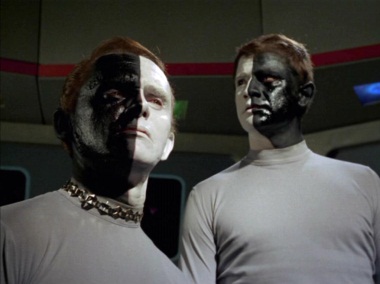
In a very classic episode of Star Trek, “Let That Be Your Final Battlefield,” the Enterprise encounters a fugitive and his pursuer. One’s body is black on the left side and white on the right side. The other’s is the opposite—and the two hate each other. So, the episode’s first point is that a small ethnic marker can produce hate that is neither fathomable nor flexible. These two aliens hate each other, and are willing to burn down everything around them in order to kill the other. As a result of this hatred, when the two return to their home planet they find it devastated.

The important aspect for scholars of international relations is the role played by the Enterprise crew—as bystanders. The two aliens so hate each other that there is nothing than an outsider can do, despite their best efforts and best intentions. The implication for us: ancient hatreds means outsiders can do nothing. Perhaps Bill Clinton did not need Robert Kaplan’s Balkan Ghosts on his bedside table to be reluctant to intervene in Bosnia—all he had to do was remember the classic Star Trek episode.

In the 1990s, a new sci-fi show focusing on a UN-esque space station, Babylon 5, also tackled the problem of ethnic conflict. In the episode “Geometry of Shadows,” one subplot, played mostly for laughs focused on one of the groups of aliens, the Drazi, that were mostly in the background during the series. But in this one episode, conflict breaks out among the Drazi. As the crew of the station investigated, they realized that there were two groups fighting each other. Every so often, their entire society fights. This ritual begins by members of the society randomly picking from a box a green or purple scarf. Once one has a green scarf, all greens become allies and all purples become adversaries. And then they fight. Once the fight is over, the winner gets to unify Drazi society.

This notion of identity is very distinct from Star Trek’s and much more akin to what many scholars have been arguing—that identity is constructed, that the content may not matter so much, but that social identity theory tells us that minor differences can create significant cleavages. In an era where Milosevic moved quickly from Communist to nationalist, this view of identity made a great deal of sense. This view also has implications for international relations—that one can intervene quite easily since identity is really thin and flexible. In the show, one of the station’s crew steals the scarf of one of the leaders and then is the leader of one of the factions, making it much easier to come to a settlement.

The reality, of course, is that ethnic identity is neither as fixed as Star Trek suggests nor as fluid as Babylon 5 asserts. Likewise, intervention is neither impossible nor easy. Outsiders can play a role as others have discussed in previous posts here, but intervention is neither certain nor always successful.

I am just curious about the next generation of science fiction to see if the fictional view of identity continues to evolve and whether it matches how scholars of ethnic conflict think about identity. All I know is that as long as I continue to teach about the IR of Ethnic Conflict, I will continue to show these two episodes to illustrate how we think about ethnic conflict and its implications for intervention.

Poliscifi II: War Sanitized

By Joseph Young

“A Taste of Armageddon.” Via Memory Alpha.

After receiving generally positive feedback about poliscifi I thought I’d dip my toes in that water once again — it’s easy for me you see.  My father is an avid Star Trek fan. He grew up with the old episodes, and when I was a kid we would watch The Next Generation and reruns of the original series together. Today, my kids watch shows like Dora and Blues Clues, but I was raised on Trek, the Hulk, Spider Man, and Star Wars (ever wonder why I’m so interested in violence?). One episode which my father and I watched several times together, “A Taste of Armageddon,” is some of the best poliscifi of all time.

This episode follows Star Trek’s main script: Captain Kirk and friends find a planet, encounter people that look a lot like us and are a threat to the crew and the Enterprise, and Kirk and friends (not the red guys, they always die) must find a cagey way out. It diverges a bit as I don’t recall Kirk being smooth with the ladies. Anyway, the critical details are these: the planet has had a long feud between two rival civilizations. Rather than continue to decimate each other in war, the two nations instead engage in a computer simulation. The simulation is a classic war game that allows a computational model to provide attacks and counterattacks and selects the individuals that “died” during the game. These individuals are then sent to disintegration chambers — the ultimate in sanitized conflict. This practice reduces the destruction of buildings and the environment, and created a stable equilibrium. What does this have to do with Kirk, Spock, and the good Doctor? They, of course, are selected for disintegration and have to convince the two parties of the madness of the whole endeavor.

Like many Star Trek episodes, this story is an allegory set in the shadow of the cold war. Regardless of Gene Rodenberry’s intent, “A Taste if Armageddon” provides some fodder for discussions of our current Drone War. Let’s assume that Peter Bergan is accurate, and the US has not killed a single civilian this year in Pakistan. Is this form of war moral?  We can also assume Peter Bergan is mistaken, and then ask the same question. If we have operators/pilots managing a machine, killing alleged militants in Afghanistan in the morning and in Yemen after lunch, how different is this than the game from Star Trek? Sure, it may be a bit more one-sided, but the remote killing of the drone war has the same sanitized feeling. Not surprisingly, some observers chafed when news broke that the Pentagon is considering awarding Medals of Valor for drone operators/pilots.

Returning to the Enterprise, Captain Kirk gives an impassioned speech to one of the leaders of the warring nations in an attempt to end the war game:

“Death, destruction, disease, horror…that’s what war is all about…that’s what makes it a thing to be avoided. You’ve made it so neat and painless you’ve had no reason to stop it…we can admit we’re barbarians but we’re not going to kill today.”

The current debate over drones is often couched in utilitarian terms and arguments that US forces “are killing fewer civilians by using this pinpoint technology.” By using this sanitized version of war, are we also potentially numbing our population to its horrible costs?

Follow

Get every new post delivered to your Inbox.

Join 184 other followers

%d bloggers like this: