Skip to content

Archive for June, 2012

Ungoverned Spaces

By Joseph Young

The term failed state is a failed concept. It suggests that the modern state is a binary outcome—there is or is not one. States in the international system are more fluid. The ability of the state to be a state—provide security, services, rule of law, and other important public goods can vary even within a single country (See Paul Staniland’s excellent recent essay on this issue in the context of civil war). We all know that state power varies across time, but this power also varies across space.

Who or what is a failed state? Afghanistan? Not exactly. Iraq. Same answer. Somalia? Getting warmer. Is the US a failed state? Certainly not. But imagine the worst, most vile neighborhood you have been to, then you have a sense for how even a stronger state like the US has some less governed spaces. Once when I encountered people in the Brazilian Amazon whose Portuguese was worse than mine, I realized how short the long arm of the Brazilian state could be. The danger, of course, with these spaces is that someone else often decides to govern. In the favelas, or shantytowns, in Brazil this alternative may be a drug cartel. In Somalia, it is Al Shabab, an Islamist insurgency.

These less governed spaces are most dangerous for their residents but also for countries that have enemies that might hide in them. In sum, these less governed spaces are a problem of domestic and international security.

Our attention at Political Violence @ a Glance has been on Syria. In the midst of the current violence, ungoverned spaces are blooming. William Hague, the foreign secretary of the UK, announced that he believed Al Qaeda operatives were in Syria taking advantage of the chaos. In the fog of war, it is difficult to know what is true and who to believe. Syrian state-run TV blames Al Qaeda for the Houla massacre. What most people are certain of though is that foreign fighters, some connected or sympathetic to Al Qaeda are moving into the empty spaces during this crisis. This is not new territory for some as the Syrian regime was likely passively allowing fighters to flow through their territory on the way to Iraq at the height of the insurgency (2004-2007).

Aside from the obvious issue of having foreigners with a death wish in the midst of a hurricane of violence, another concern is allowing a zone of lawlessness to persist and provide shelter for extremists. Recent conflicts in Mali and Yemen have created such zones where Al Qaeda and groups adhering to similar radical ideologies operate in the open and act like wanna-be states.

As someone well-versed in political realism, I understand the case for non-intervention in Syria. It is difficult to establish a global coalition. The UN is feckless at best. NATO is worried about Russia. The US and its allies (and the publics of each) don’t have the stomach for more war.

Analogies are probably not helpful as they can be used to bolster either case. Syria is another Libya, did that go well or badly? Syria is just like Serbia, bomb them and we can stop the bloodshed. Syria is another Vietnam, isn’t every conflict?

I want to avoid analogies or pessimism and draw attention to the fact that the status quo and nonintervention in Syria could have second order effects, read unintended consequences, for international security. Most importantly, the violent groups that the US and its allies have been chasing across the globe might find refuge in the chaos in Syria.

Syria, Libya, and the Responsibility to Protect

By Andrew Kydd

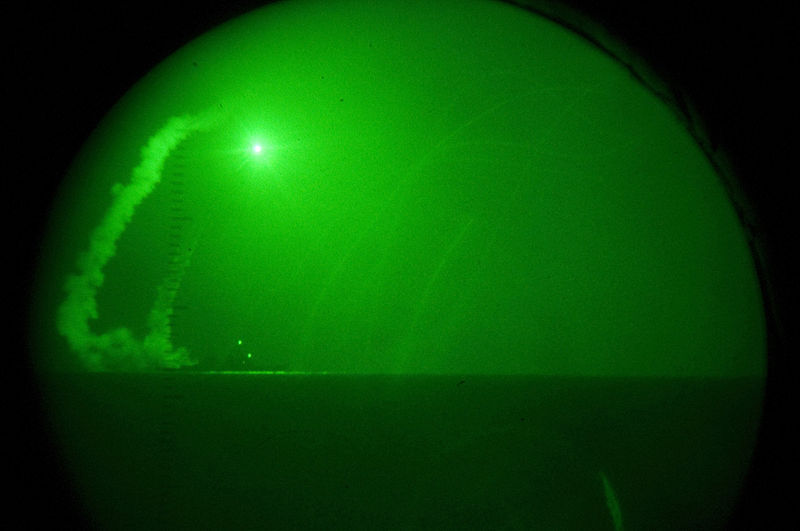
US Navy vessel firing in support of the NATO intervention in Libya. US Navy photo by Mass Communication Specialist 1st Class Nathanael Miller, via Wikimedia.

Over ten thousand people have been killed in the fighting in Syria, and the Assad regime has committed a number of atrocities against civilians, including the recent Houla massacre. NATO intervened in Libya with far less provocation, and this was declared a triumph of the UN Responsibility to Protect (R2P) doctrine, which holds that the international community has a responsibility to protect civilians if they are under attack from their own government. This triumph must surely ring hollow for the families of Assad’s victims today.

In truth, R2P’s application to Libya was seriously flawed. First, the Libyan regime did not commit large scale massacres before NATO decided to intervene. At best, NATO acted preventively, to head off a potential massacre that might have happened had Qadaffi’s forces retaken control of Benghazi, the rebel stronghold. And in the implementation, NATO clearly did not simply attempt to protect civilians, as its UN mandate dictated, they became the rebel airforce and did not stop their strikes until Qadaffi was dead in a ditch. Current opponents of intervention in Syria such as Russia and China are unlikely to have forgotten that an inch of R2P was turned into a mile of regime change.

Can R2P be redeemed in Syria? What would such an intervention look like? The usual concept is an overall threshold for civilian fatalities, that, once crossed, leads to all out intervention to overthrow the regime. This has some points to recommend it, but suffers from two drawbacks: it generates opposition from regime supporters and the cost may deter action, resulting in too high a threshold.

Consider a lower threshold alternative. Imagine if NATO adopted a policy of destroying a government tank, artillery piece, or other military asset for every ten civilians killed by the regime. A massacre such as Houla in which around a hundred civilians died would cost them five tanks, four guns and a helicopter. Massacres committed by the rebel side could be punished more subtly by interdicting supplies from their backers such as Saudi Arabia. Such a policy would at least provide incentives for each side to minimize civilian casualties. It would also shift the balance of power in favor of the rebels, because it would hamper the regime’s use of its advantage in hardware. This is probably ok with the NATO countries, though objectionable to Russia. The main drawback is it might also prolong the war, which would frustrate NATO publics and might in the end lead to more fatalities over time. McArthur was not alone in preferring victory to prolonged indecision. But R2P is meant to produce cleaner fights not quick victories.

Angels and Anarchists: A Conflict Scholar’s Response to Steven Pinker’s New Book

By Christian Davenport

In his popular new book The Better Angels of Our Nature: Why Violence has Declined Steven Pinker claims that violence has decreased over time—and that the reason for it is that humans have become more civilized. The main story is ambitious as much as it is happy. According to Pinker (and this is a gross-bloglike simplification), we kill less now because we have done away with such things.

After looking at political violence data for about 20 years and witnessing Darfur, the DRC, and Rwanda over the last few decades, I have my doubts.

First, there are immense gaps in the data Pinker uses to support his main argument. There is no comparable violence data over the full time period in question. Rather, different data sources compile data from different raw materials over distinct geographic regions over different periods. Crucially, there is no data on violence by the leading killer of human beings—governments—for most of the period of interest. There is also no comprehensive data for the main independent variable of interest—civilization—such as public opinion or values data.

Second, Pinker overlooks various dimensions of violence, such as frequency, scope, type, degree/magnitude, targets, etc. Considering these criteria, it’s clear some aspects of violence have diminished over time—but only in certain parts of the planet and in certain ways. People are still being mugged, beaten, raped and even killed in mass numbers, but most large-scale violence has diminished. Pinker’s take on this “pacification process” is a bit more optimistic than my own. In my view, states engage in not less but different levels of severity—for example “torture-lite” (e.g., immobilizing individuals to make them more physically manipulable instead of old-school torture such as removing skin from individuals, stun grenades instead of real ones, improved surveillance that helps governments identify problems before they arise, and lifelong imprisonment of problematic youth to pre-empt future political challenges). OK, so maybe the magnitude of violence has been diminished (which Pinker says) but the form may have shifted (which he does not).

By my logic, we should not be surprised that fewer blacks are lynched over time in the United States when the majority of the relevant population is busily harassed by police at a corner near you, is sentenced to stiffer sentences, is incarcerated and is less likely to be paroled (throughout the country). I would not suggest that America has become more “civilized” with regard to its treatment of African Americans but, rather, they have generally finished with their domestication efforts. Not really an overall “civilizing” process by my book.

This brings us to my third point: why does violence decrease? This gets at the core of Pinker’s argument. Are we more civilized? What does this mean actually? Who is the “we”? If violence truly has declined, I think it’s because governments have generally won. What I mean is that in general, the global ideological spectrum has been purged of the most “dangerous”, disruptive ideas. Who is now trying to destroy capitalism, disrupt the military-industrial complex, trying to redistribute resources; and how are they suggesting we go about doing this? What happened to those who did: anarco-syndicalists, luddites, socialists, and communists? State violence has decreased because states don’t need to kill anymore. We still have “anarchists” but the current group has no Kropotkin, no sophisticated diagnosis of the problem or its resolution—the diverse components of a social movement. “Anarchists” now squat in the middle of protests and try to provoke governments to “reveal” their coercive nature—like in the recent anti-NATO protests in Chicago. Governments possess a strong numerical advantage, issue “dispersal orders”, intimidate bystanders to leave, charge those left with an illegal assembly, and get CNN to diligently report every illegal move and legalized countermove. In the current context, governments simply need to “manage” challengers and/or challenge.

Like Pinker, I suppose I do believe that evolution plays a role, but not in the way Pinker suggests. In some work with Rose McDermott, I argue that governments manage challengers by using violence against radical claims-makers (e.g., those seeking displacement of power-holders) and accommodating or co-opting those with reformist objectives. Over time, this would lead to citizens engaging in less challenging challenges and, as a result, less government violent activity. With state victory, it makes sense that most other forms of violence would be diminished. The hierarchy is clear—the alpha entity has emerged, and the domesticated population is left with iPods, iPhones, iTVs and iLives to keep themselves occupied. We are beaten, homogenized and apathetic, not civilized.

Fourth, the idea that there is one explanation for all forms of violence appears to violate everything that the micro-foundational and sub-national conflict movement has been arguing over the last decade. This is a movement that has produced the most sophisticated, detailed, and nuanced arguments as well as data in the history of conflict studies.

This said, Pinker caught onto something that most in the conflict community did not. He looked at plots of the data over time and reflected on what they might mean. But conflict scholars should not let this book go by as yet another “accidental tourist’s” brief visitation without critically engaging it. If he is right, then I will be among the first to say thanks for pointing out our angels. But, we need to know if he is or isn’t. To address the topic, we would need to explicitly measure and test alternative propositions. Pinker did not do this. I think that our field should step up to the challenge and, for starters, I suggest pointing out our lack of anarchists.

Got time for one of the most pressing questions in human history?

Update: The title of this post has been altered for clarity.

Syria Outcome @ a Glance

By Joseph Young and Erica Chenoweth

As our readers know, we have devoted a great of attention to Syria for the past week or so. We polled our contributors and asked them two questions:

What should happen in Syria?

What will happen in Syria?

The first question asks the respondent to play God and the second to play Nostradamus. With sufficient humility, we offer the results of this non-scientific poll of social scientists.

In sum, a majority (60%) of our contributors think that the rebels will increasingly receive military support (weapons, intelligence, training) but NOT direct intervention. Joe Young suggests that:

“The US and international community cannot directly intervene because of objections by Russia/China. By default, the US, France and others will arm and work with the Syrian resistance until Assad is ousted.”

One brave soul (Will Moore) believes that direct intervention may occur but only by “France and/or Turkey” and only “with air support.”

Matt Kocher offers the somber assessment underlying the majority position over what is most likely to occur:

“Nobody with the capacity has the stomach for a full-scale intervention in 2012, but the situation is dire enough that many international actors will not be able to stay completely on the sideline. I foresee a long, slow muddling through and a protracted civil war.”

Oliver Kaplan agrees:

“As a relatively costless and scalable option for international actors, there will likely be increased arming and training of opposition forces. In fact, this is probably occurring already. This could help bring about the defeat of government forces, but could also lead to protraction of the conflict.”

Of course, in the real world what should happen and what will happen does not necessarily coincide. Interestingly, a plurality (48%) felt a diplomatic solution should occur. Page Fortna, an expert on peacekeeping, suggests:

“For [a diplomatic solution] to have any chance of occurring, the broker will have to be acceptable to both sides, and my guess is that of the 3 listed possible brokers a US/Russia mediated deal is most likely to be acceptable to both the government and the opposition.”

By contrast, Barbara Walter feels this is the worst possible outcome as

“(a) neither side has incentives to compromise at this point, and (b) even if they do have incentives to accept a compromise, it would be enforceable over time only with a significant commitment of outside peacekeepers – something no country will be willing to commit. Pursuing a diplomatic solution, therefore, is simply kicking the can down the road.”

Roland Paris offers a potential bridge between the divide between Fortna and Walter. He would like a regional solution and sees the most desirable outcome as a

“negotiated solution brokered by the Arab League, supported by a contact group that includes UN permanent members plus Turkey. To include political roadmap plus a peacekeeping force made up of Arab troops (perhaps a hybrid UN-Arab League mission).”

And Oliver Kaplan suggests that the international community should focus the most on using wedge strategies toward Assad’s Alawite supporters:

“Perhaps the Opposition Council or international actors can devise an explicit policy to protect Alawites, find a cross-cutting cleavage to exploit, and step up communication with civil society and political leaders to try to provide them reassurance (e.g., that they will benefit in any change in regime)….if such a move works, it could sap support from the government and eventually lead to its defeat.”

Erica Chenoweth also argues that the international community should focus less on arming various actors, and more on separating Assad from his main pillars of support:

“The international community should offer ‘golden parachutes‘ (e.g. money, protection, and immunity) to any regime insiders who wish to leave the country and stop supporting Assad.”

Will Moore was one of only two with the same answer for what should and will happen. Although he changes his answer on who should be the intervener, he argues that, “the UN should intervene with ground troops per chapter VII of the UN Charter.”

What do you think? What should happen? What will happen? We will continue to monitor and offer our opinions. Hopefully, this is not a topic we will revisit next year. If the majority opinion is accurate, however, it very well could be.

How Likely Is Nuclear Terrorism? Part Two

By Matthew Kocher

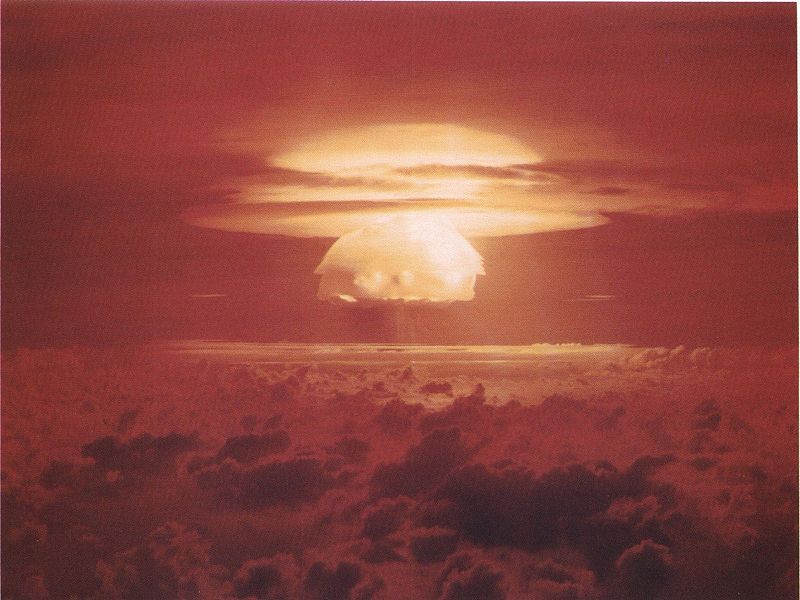
US Department of Energy photo, via Wikimedia.

This is the second post in a two-part series. Part One here.

In part one of my post, I made the case that some fairly influential policy experts on nuclear terrorism have no idea what they’re talking about. Or, to be more specific, they’re making predictions with no empirical foundation, because there is no empirical foundation (i.e. no data) to be had.

But, some of these experts are pretty smart people, and they know much more than I do. So, what are they basing their conclusions on? My take is that nuclear terrorism experts are doing something much closer to theory than to research. Or, perhaps a better way to put it is that their research is shot through with possibly true, but in any case highly contestable, assumptions about how the world works. In his book Atomic Obsession, John Mueller does a very nice job of demonstrating how this type of work is done, and he provides his own example. The trick is to construct a model of the steps a terrorist group would have to go through in order to get a nuclear weapon, transport it to the target, and successfully detonate it, while evading the security systems designed to stop them. Many of the steps in the process are fairly pedestrian activities about which a fair amount is known (e.g. smuggling). So, the expert assigns probabilities of success at each step then aggregates the probabilities to generate an overall probability of success.

This procedure is not ridiculous on its face, but it involves tremendous uncertainties at each step of the model-building process. And, at the end of the process, as I said previously, there are no data against which to test the overall adequacy of the model. That makes it nearly impossible to construct compelling tests between, say, Graham Allison’s and John Mueller’s models.

This brings me to my real point, which is that when experts opine about policy, as we are doing here, it’s usually quite a bit like the nuclear terrorism case. Okay, it’s normally not as bad, since most of the time we do have data on the outcome and we can try to fit a model to the data. But, in my experience, expert policy recommendations normally depend on some fairly heroic untested assumptions, whether the recommendations are based on surveys, formal modeling, ethnography, applied statistics, experiments, or generalized area expertise. One of the most useful things experts can do for the public is to help hold other experts accountable by, among other things, explaining these assumptions and how they are used to generate policy recommendations.

Starting a new policy blog, it is worth keeping in mind Philip Tetlock’s findings on Expert Political Judgment: on the whole, it’s pretty bad. Experts can partially ameliorate this problem by keeping in mind Jon Elster’s paraphrase of Socrates: “perhaps humility properly conceived is part of competence.”

Ethnic Groups Are Not states

By Lise Morjé Howard

Ethnic groups are not states. This simple fact seems to elude many journalists and, on occasion, scholars. But my aim in this post are journalists and in particular the June 5, 2012 New York Times story about the controversy over the Askariya Shrine in Samarra, Iraq, “Violence Spreads in Struggle for Shrine” by Tim Arango and Yasir Ghazi. In the story, the reporters depict the conflict as “a dispute escalat[ing] between Sunnis and Shiites.” It discusses Sunnis and Shiites as if they are distinct, bounded, groups fighting one another because of past grievances. The journalists don’t question this “groupist” position in their own reporting. They do, however, offer two quotations from Iraqis that directly contradict the groupist ontological understanding of ethnicity.  One Iraqi asks, “what did the victims of today do to be killed?  Sectarianism has no mercy against anyone, and there are groups of criminals and militias used by officials and politicians to achieve their specific agenda.” Another says, “They are not fighting for the shrines; they are fighting for the money that these shrines can bring to them. It’s just another way to play with people’s emotions to gain advantage.” Both of these quotations offer a Rogers Brubaker-type approach to understanding ethnicity and conflict: conflict is waged between leaders and their organizations who manipulate ethnic identity for narrow gain. Violent conflict does not occur between bounded, whole, discrete ethnic groups for the very reason that ethnic groups are not bounded, discrete wholes. Ethnic “groups” are messy, dissimilar units. They are not like states because they don’t have features such as clear, internationally-demarcated borders or legitimate domestic legal systems. Members of different ethnic categories blend together, cross borders, and interests can be extremely heterogeneous. Some ethnic groups have clearer boundaries than others. Ethnic groups do not fight one another in similar ways that states do, because ethnic groups are not like states. We err when we treat ethnic groups as distinct wholes—scholars and journalists alike have much to learn from those Iraqis quoted in the article.

How Likely Is Nuclear Terrorism? Part One

By Matthew Kocher

This post is going to be in two parts. In the first, I make a substantive point about nuclear terrorism, an issue I’ve wanted to address for some time. In part two, I build off my views on nuclear terrorism to make a meta-level point about what experts have to offer a general policy audience and how that audience should receive what we have to say.

Back in 2008, in a New York Times Op-Ed, the national security journalist Jeffrey Goldberg wrote the following about the prospects for a nuclear detonation by terrorists in the US:

“Many proliferation experts I have spoken to judge the chance of such a detonation to be as high as 50 percent in the next 10 years. I am an optimist, so I put the chance at 10 percent to 20 percent. Only technical complications prevent Al Qaeda from executing a nuclear attack today.”

Goldberg doesn’t name these proliferation experts, but he’s a careful reporter with an excellent reputation, so I think we should presume he faithfully reported what he heard. Goldberg’s Op-Ed appeared about 2 months before the final report of the Commission on the Prevention of WMD Proliferation and Terrorism, which came to similarly alarming conclusions. The Commission was led by Graham Allison, the former Dean of the Kennedy School of Government at Harvard and one of America’s most influential experts on international affairs. Allison worked with a team of governmental and non-governmental experts on nuclear proliferation; he had a large budget to work with; the Commission staff traveled all over the country and the world interviewing top experts in the field. So, here we have an example of security experts giving advice on policy, in this case through a journalist and a government commission rather than directly to the public, on issues of fundamental importance to national security. As critical consumers of policy pronouncements, what should we make of these claims?

I am not an expert in nuclear terrorism or proliferation, and I have done no significant research on the topic. Thus, in this particular case, I’m in the same boat as the general consumer of policy expertise. Yet, even knowing very little, I think we have good reason to assign essentially zero credibility to these claims. The reason is simple: to the present time, no terrorist group has ever used a nuclear weapon; indeed, no terrorist group has ever possessed a nuclear weapon. Therefore, it is not possible to form reliable beliefs about the conditions under which such a thing might come to pass. Where we have no data, as in this case, there is nothing to extrapolate from. In cases like this one, the best thing to do is to accept that we are overwhelmed by uncertainty, and accept that the real policy problem is to figure out what to do when we know very little. In other words, the real policy problem is a philosophical one, not an empirical one.

The Goldberg/Allison perspective on nuclear terrorism has been ably criticized by, among others, John Mueller and Michael Levi. My gut reaction is that the critics are right and the odds of nuclear terrorism are really (really, really) low. Still, I think these critics are missing the more important point I make here: at the end of the day, what we know about nuclear terrorism amounts to very little, especially relative to the many assumptions we have to make to generate meaningful policy recommendations.

Syria: UN Monitors a Failure?

By Oliver Kaplan

Major-General Robert Mood in the town of Al-Rastan, Homs province, Syria. UN Photo/N. Singh

The April 12 Annan plan to deal with Syria was intended to moderate the Assad government’s behavior by monitoring, a ceasefire, and negotiation. Upon hearing of this plan, my first reaction was, how could it possibly work? How are unarmed UN monitors going to stop a government that has shown minimal restraint?

To date, the plan is increasingly looking like a failure. The head of the observer force, Gen. Robert Mood, just announced that the teams would suspend (but not end) activities because conditions on the ground have gotten so dangerous as to put the monitors themselves at risk. So are there any prospects for monitors to make positive contributions to a situation like this? I’m going to briefly consider two possible pathways here.

One way monitors might work is through deterrence. A government might think twice about committing mass violence if it values its international reputation and fears retribution and its reputation being hurt as its actions are exposed to the world. Unfortunately, this scenario does not appear to apply to Syria–violence was committed both before and after the UN monitors. Even though news reports note that Annan is still holding out hope that his peace plan may succeed, rather than effective deterrence, most analysts would call this a deterrence failure. Deterrence has likely failed because the deterrent threat was not credible—at the outset there was not enough consensus among the parties to act with coordination and sufficient pressure.

However, deterrence, or better put, immediate deterrence, may not be the ultimate path through which Annan’s monitors affect the course of the conflict. In an alternate pathway, monitoring may instead end up building consensus for further countervailing action. If monitoring does not immediately stop the fighting itself, by extending the olive branch and giving the transgressor (in this case, Syria, although the opposition is also a belligerent) a chance to show restraint, the (impartial) UN monitors may at least provide a signal that exposes the transgressor for what it really is to the outside world. The monitors help draw a line in the sand–a line not to be crossed.

One could point to this kind of process in the civil war in Colombia. In 1998, President Andres Pastrana agreed to a ceasefire and negotiations with the FARC insurgents, ceding large swaths of territory to the rebels. Negotiations broke down four years later, by which time the FARC had used the safe haven to re-arm, and this controversial move was seen as a failure. However, the FARC’s transgressions in the face of the government’s olive branch revealed them to be ruthless fighters, rather than diplomatic revolutionaries. This galvanized the public and created additional political support for building up the military and for more aggressive counterinsurgency measures.

In the case of Syria, the holdouts, Russia and China may be the objects of the monitor-induced consensus-building. In a positive move, Russia and China voted along with the rest of the UN Security Council to condemn the Houla massacre after receiving reports from the UN monitors. But Russia and China have not yet supported further action against the Syrian government, and new information alone is not immediately likely to shift the actions of such countries with entrenched political preferences on the issue–at least not directly (especially since these countries can throw up their hands and claim ambiguity in who is to blame for violence given armed resistance by the opposition groups).

However, the monitors’ signals might still be able to indirectly influence holdout countries. Similar to colleague Barbara Walter’s argument that the Assad government’s violence against civilians may be designed to intimidate moderates and shift their support away from the opposition, the reporting of this violence might also mobilize moderate, fence-sitting countries that were standing back to begin pressuring the more powerful Assad supporters. This process resembles the cascade of reassurance that is a central part of models for protest and revolution within countries: as new information induces only slightly reluctant moderate countries begin to participate in pressuring Syria, they provide cover (or additional pressure) for more action-averse countries to take the “risk” of joining-in. Eventually this process may reach the most reluctant or recalcitrant countries (or their publics).

This model raises some important questions: who are the first-mover moderate countries? Will they be induced to act, and when? How many countries have actually been induced to act since Annan plan, and did they (will they) shift due to the Annan plan’s monitors, or just the blatantly increasing intensity of conflict? Which of these countries might pressure the holdouts, Russia and China? And, would the withdrawal of these countries’ support to the Assad government actually work to moderate its behavior?

Whether nations will be galvanized and able to act is not yet clear, but the signals from news reports and UN monitors increasingly are, now that they themselves have become threatened. The next step will be what to do with any eventual consensus that arrives. Given the general distaste for intervention a New York Times editorial last week called for “comprehensive sanctions,” but would these punishments be enough? Or would other options be required? This will certainly be examined in future posts on this blog. In the meantime, as these questions are resolved they will help determine whether or not monitors really are a win-win policy that produces either successful deterrence or a broader consensus for more powerful actions.

Explaining Communal Violence in Myanmar

By Kristine Eck

Sittwe, capital of Rakhine state, Myanmar. Photo by Joakim Kreutz.

The past week witnessed the outbreak of communal violence between the Muslim Rohingya and the Buddhist Rakhine in Myanmar’s Rakhine State which led to the deaths of at least 35 people. Communal violence between these groups is not new. This violence is particularly problematic because it runs counter to the good news stories otherwise coming out of Burma (the holding of free by-elections, Aung San Suu Kyi’s participation in governance, ongoing peace negotiations, the suspension of sanctions, and a foreign investment frenzy).

Internal data from the Uppsala Conflict Data Program (UCDP) indicate that episodes of violence have flared up at least four times in the past 20 years. Is this violence different from previous years’ and how do we explain it? The UCDP data suggest that last week’s episode led to more fatalities than similar clashes in the past. One possible explanation for the higher levels of fatalities is that the media, and social media like Facebook, are inflaming the situation by facilitating the spread of rumors and hate speech. While research has found that rumors are an essential component of violent dynamics in riots, this is not likely to explain the escalation of violence in Rakhine state for the simple reason that internet access is poor across the state, limiting the population’s exposure to it. Internet hatemongering may, however, effect the likelihood that anti-Muslim communal violence spreads to other parts of the country, which themselves also have histories of communal violence.

I’m inclined to relate the intensity of the current violence in part to the response of the Myanmar state. While previous governments have been complicit in encouraging communal tensions, the outbreak of communal violence was suppressed through heavy-handed repression: mass arrests, curfews, and the imposition of army troops. While the current government has deployed troops to the area, it has struggled to use them for policing without resorting to the types of human rights violations it engaged in under previous regimes. With the current moves towards a democratic transition, the state is more constrained in its use of coercive force. In a working paper with Joakim Kreutz, we find that regime transitions function as a window of opportunity for communal leaders to exploit the decreased deterrent capacity of the state. In such periods, the state is less able to contain the problems of communal opportunism that are otherwise restricted by the threat of punishment from formal institutions or in-group policing structures. We suggest that this problem will be particularly acute for regimes transitioning away from autocracy; when excessive force is the norm, anything less is seen as a signal of institutional weakness. Other research on communal violence between Muslims and Hindus in neighboring India support the idea that state incentives to punish perpetrators is essential to understanding the intensity of communal violence.

In addition to Myanmar’s existing armed ethnic conflicts, we can expect that the process of democratization will lead to further outbreaks of violence involving minority populations like the Muslims, Chinese, and other ethnic groups which constitute minorities within their states. These groups all lack political representation and coupled with the current scramble to stake out political and economic claims, the situation in Myanmar holds the potential for new outbreaks of violence.

Why Assad Will Fight to the Death

By Barbara F. Walter

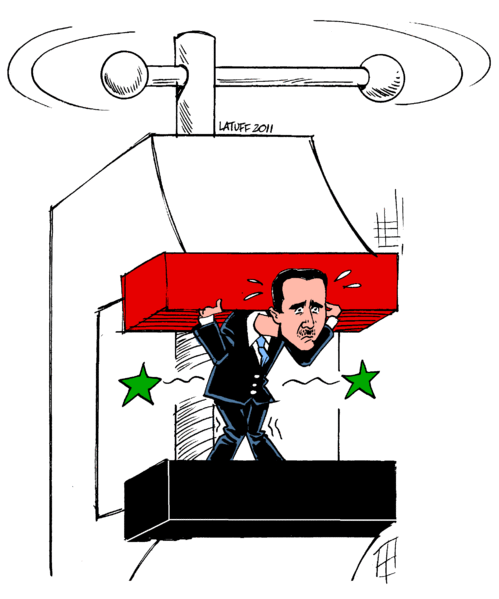
Cartoon by Carlos Latuff, via Wikimedia.

A striking fact about civil wars is that the outcome is often clear months or even years before they actually end. Jefferson Davis knew he would lose the American Civil War after the fall of Atlanta, yet continued to fight. Muammar Qaddafi almost certainly knew he would lose the war in Libya as soon as NATO assaults began, yet he continued to fight. The same is true in Syria. Syrian President Bashar al Assad continues to fight despite increasing evidence that he cannot win. Why does Assad continue to fight despite declining odds and what does this suggest the U.S. should do?

Assad continues to fight for two reasons. First, he knows he cannot negotiate his way about of war despite offers by Kofi Annan to do so. From Assad’s perspective, any real offer to share power would be tantamount to a decisive defeat. Agreeing to open up the political process to a group that represents 70% of the population would be equivalent to Assad agreeing to a minority position in the new government. And a minority position in government would make him vulnerable to reprisals in the form of imprisonment or death at the hands of a vengeful population.

Even if Assad were to agree to a compromise deal, the opposition has its own reasons to reject a settlement. Assuming they could unite, why would Sunnis and Christians trust that Assad would continue to share power once they laid down their weapons? Violence and the continuing threat of violence is the only tool they have to keep Assad in line and they will almost certainly be deeply skeptical of any promise by Assad to change.

Assad could voluntarily cede power, spending the rest of his days in comfortable exile. But this is the second reason he continues to fight. Assad knows that a safe, comfortable exile is not an option for him. In the past, hated dictators have sometimes chosen exile when defeat seemed likely. The Shah of Iran did it in the 1970s, Ferdinand Marcos did it in the 1980s, and Ben Ali did it last year. This option isn’t open to Assad and this is what makes fighting to the finish attractive to him.

Assad cannot go into exile because exile leaves him vulnerable to prosecution by the International Criminal Court (ICC). Assad’s problem is that he signed the Rome Statute of the ICC, giving the Court the right to prosecute him if he engages in crimes against humanity – something he has clearly done over the past year. In fact, Secretary of State Hillary Clinton publicly confirmed that Assad could be prosecuted for war crimes. This places Assad directly in the sightline of the ICC.

So what will happen? History suggests that Assad will continue to fight with the aim to decisively defeat the rebels. He will hope that Iran and Russia will continue to support him and that the international community will not intervene. But time is not on his side. Continued war and economic sanctions will make his regime weaker. This decline may convince him to eventually accept a compromise settlement, but this offer is likely to be rejected by an opposition that does not trust him. Exile isn’t a good alternative. Few states are likely to accept him or credibly promise to protect him over time.  The most likely outcome, as it was with Qaddafi, is defeat and death.

Perhaps this is not a bad option for the United States. Syria will get a new government under majority Sunni leadership without the U.S. having to commit any additional soldiers to the Middle East. It will be a home-grown movement that deposes a hated dictator and one who had been a longtime enemy of the United States. Military and financial aid to the rebels could hasten this outcome. But anyone who believes that Assad will eventually agree to negotiate, or leave power quietly, ignores the strong incentives he has to fight to the death.

Follow

Get every new post delivered to your Inbox.

Join 199 other followers

%d bloggers like this: