Skip to content

R2P ≠ Regime Change

By Andrew Kydd

USAF photo by Staff Sgt. Lee F. Corkran, via (a href="http://commons.wikimedia.org/wiki/File:Mark-84_bomb.jpg">Wikimedia.

USAF photo by Staff Sgt. Lee F. Corkran, via Wikimedia.

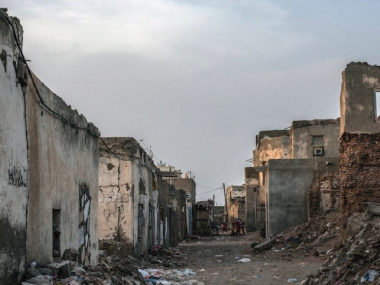
We are now past at least 70,000 dead in the Syrian conflict and mass atrocities are being committed on an almost daily basis. The Syrian government has mobilized thugs who appear to lack any military discipline or accountability. Yet Washington takes notice not of real massacres committed with ordinary weapons, but of marginal uses of chemical weapons that have killed comparatively few. Washington inches towards military support of the rebels as if this is the appropriate next step, like a medieval doctor who grimly decides the time has come to put leeches on the arms as well as the legs of a dying patient. Meanwhile, we are treated to the absurd suggestion that we should invade Syria and reconstruct the state in order to intimidate Iran into giving up its nuclear program, which calls to mind Einstein’s definition of insanity, doing the same thing over and over and expecting different results.

Part of the problem is that Washington equates intervention with regime change. In Libya, UN approval for an intervention to protect civilians was used as a license to overthrow Qadaffi. To outward appearances, there was no serious reflection in the administration about this, and no one arguing that this was a mistake. This stands in marked contrast to two previous cases. First, under George H. W. Bush, the US scrupulously observed the international mandate to evict Iraq from Kuwait, but did not go on to overthrow Saddam Hussein. Neo-conservatives then began the long march to 2003, when this restraint would be abandoned, with results that are plain to see. Second, in the Kosovo case in 1999, NATO conducted, without UN permission, an air campaign to evict Serbian forces from Kosovo. The campaign ended before Milosevic was overthrown, although it did decide the issue in favor of the separatist rebels. But in neither case was intervention equated with regime change. We seem to have lost sight of this possibility, in particular, we are unable to envision any form of intervention that would protect civilians in a civil war that does not involve supporting the rebel forces. This is an enormous failure of imagination on the part of US policymakers. As we fail to come up with effective policy options, tens of thousands of Syrians are dying and the future of Syria as a unified country is increasingly cast into doubt.

Let’s therefore unbundle the protection of civilians from regime change, total victory, boots on the ground, and other things that do not necessarily go together. In particular, let’s remind ourselves of the Dayton agreement that ended the Bosnian war. In that case, airpower was brought to bear against Serbia, but not to the point of total victory for the Bosnian Muslims and Croats. Instead, it was used to convince the Serbs that total victory was beyond them, and to facilitate the creation of a front line that would be the basis for subsequent negotiations. Those negotiations then became the focus, and neither side got what they wanted. However, the killing stopped. The resulting state of affairs can hardly be called a unitary state, and it might have been just as well to arrange an outright partition. And yet, thousands of people are alive today who would be dead if the US had not acted as it did. Despite the counsel of the critics of “liberal interventionism”, that counts for something.

Friday Puzzler: Why Don’t Anti-Drug Campaigns Highlight Violence?

By Taylor Marvin

Image by Flickr user Jan Vrsinsky.

Image by Flickr user Jan Vrsinsky.

It’s frequently argued that US drug consumption drives drug trafficking-related violence in Latin America, especially Mexico. If it wasn’t for the high demand for drugs in the United States, so the argument goes, trafficking routes through South and Central America would be less lucrative, and less worth fighting over. President Obama cited this reasoning on a recent visit to Mexico, noting that the country’s drug trade-fueled unrest is partially the fault of the United States.

However, American youth-focused anti-drug campaigns like abovetheinfluence.com typically only highlight the health effects and life problems associated with illegal drug use. Admittedly, many young potential drug users wouldn’t find violence inflicted on others a convincing reason to abstain — but many could, and campaigns highlighting cartel-related violence would certainly draw attention. So, why don’t anti-drug campaigns highlight the violent consequences of the drug trade abroad? Would this have any effect on the domestic demand for drugs?


Last week we asked why President Obama would announce a major shift in how drones strikes would be used, which would restrict their use outside of overt war zones and formally acknowledged that drones had been used to assassinate US citizens outside of Iraq and Afghanistan. Commenter John understood the announcement as a signal to foreign governments that the US was serious about reforming its drone policies:

“The administration may be worried about how the unrestrained use of drones may be perceived by other governments and wants to send a signal that it will, in the future, act within a stricter set of limits. Announcing this change publicly also helps to make the signal costly by raising the possibility of domestic audience costs if the U.S. does not follow through on its commitments.”

Barbara F. Walter adds:

“The cynical answer is that this is a relatively easy time to reform the drone program because so many al Qaida leaders have already been killed. The fewer big, important targets, the less critical it is to maintain secrecy and absolute control.”

Elsewhere, other writers were doubtful Obama’s speech signaled any real policy shift at all. Writing in Foreign PolicyElias Groll notes that Obama’s wording has “given himself a carte blanche to carry out attacks in Afghanistan and Pakistan.” Similarly, Slate’s Fred Kaplan writes that the speech has little practical significance, though Obama’s stated desire to benchmark potential strikes around avoiding civilian casualties imposes “a real restriction” on the scope of the program.

Weekly Links

By Taylor Marvin

Map of the British Empire, 1886. By Colomb, J. C. R., via Norman B. Leventhal Map Center.

Map of the British Empire, 1886. By Colomb, J. C. R., via Norman B. Leventhal Map Center.

Britain, France urged to show restraint before arming Syrian rebels. And just how formidable are Syrian air defenses? Last year Brian T. Haggerty looked at the requirements of an air campaign (pdf).

How Qatar seized control of the Syrian revolution: “People will remember those who gave without having an agenda. The Syrians are clever, they know when there is an agenda.”

Reminders of just how complex the Syrian conflict is: Rebels guard a government-held, and indispensable, hydroelectric plant, and John McCain accidentally posed with rebels accused of kidnapping Lebanese Shiites.

Finally, The Atlantic collects recent photojournalism from the conflict.

In Afghanistan, a bombing and a graduation.

The Iranian government beefs up security in the rapidly-developing lead up to next month’s election.

The Federation of American Scientists looks at the economic costs of a conflict with Iran.

The Economist talks to journalist Jeremy Scahill about his new book Dirty Wars: The World is a Battlefield.

Excellent blog The Smoke-Filled Room has started a weekly reading list. Check it out.

Everyday Counterterrorism

By Joe Young

A brutal murder of an off-duty soldier in Britain on Wednesday brought out the good, bad and the ugly in human beings. The Ugly: two young men attacked a man wearing a t-shirt that identified him as a soldier. Allegedly, the men slaughtered him because he was complicit in the murder and subjugation of Muslims in Afghanistan and Iraq. The Bad: members of an extreme nationalist group, the English Defence League, came to the scene of the crime quickly and further stoked anger. Several mosques were attacked after this crime.

The Good: A woman, Ingrid Loyau-Kennett, a cub scout leader, rushed to the aid of the fallen man. Calmly, after attending to the injured man, she confronted the bloodied assailants. She asked why and engaged one of them. According to Loyau-Kennett (as reported by the Telegraph)

“I started to talk to him and I started to notice more weapons and the guy behind him with more weapons as well. By then, people had started to gather around. So I thought OK, I should keep him talking to me before he noticed everything around him.”

Her actions likely saved lives. The men told her that they wanted to start a war in London. She delayed future violence and identified the brutality and senselessness of their crimes. This is everyday counterterrorism.1 We’ve seen it in action over the skies of Detroit. The Dutch filmmaker, Jasper Schuringa, hurdled over other passengers to subdue the would-be underwear bomber on flight 253 while flight attendants used fire extinguishers to subdue the flames. It is not hyperbole to suggest that the actions of passengers on United flight 93 saved hundreds of other lives. And it’s not hyperbole to say that Loyau-Kennett stopped what would have been more bloodshed.

Obviously, this shouldn’t be the sum total of how we deal with terrorism, but these actions are instructive for several reasons. First, if people want to use violence, completely preventing it is nearly impossible. We (everyone) can, however, respond in ways that confront these acts and reduce their destructive power. Second, terrorism is about fear. If in these moments, people respond without succumbing to fear, as Loyau-Kennett and Schuringa demonstrated, the power of the act might be mitigated. Our secondary responses feed into this as well. If Max Abrahms is right, terrorism is a losing strategy. Our reaction to it is what matters. Erica Chenoweth and I find that terrorist campaigns are not an existential threat to democracies, and John Mueller suggests that most of the threat comes from our over-reactions. Violence sometimes seems as if it is occurring and dealt with at levels above and beyond our control. Subway signs and color-coding have been used to increase awareness and spark everyday counterterrorism, but this can easily devolve into hyper-vigilance and even more fear. Finding the optimal balance is tricky. This brutal murder in Britain, however, shows that although we can not live in a world free of terrorism, we can be effective at everyday counterterrorism.

1 There a good reasons to debate whether this act was terrorism or not. See here and here for discussions related to classifying events as terrorism.

A version of this piece was first published at the Huffington Post.

Political Violence Thought of the Week

By Erica Chenoweth

A regime aircraft over Maraat al-Numan, November 2012. Photo via John Cantlie/AFP/Getty Images, via Freedom House.

A regime aircraft over Maraat al-Numan, November 2012. Photo via John Cantlie/AFP/Getty Images, via Freedom House.

A recent article in the New York Times reminded me of recent work about why violence against civilians is so ineffective.

Referring to the shelling of several Lebanese towns near the Syrian border, Anne Barnard & colleagues document several responses by the Lebanese population:

“Residents said they believed that they were being targeted because Hezbollah, the pro-Syrian Lebanese Shiite militant group, is the political power in the village and bases some operations nearby. But Saad Hamedeh, the son of Hermel’s tribal sheik, said there were no military targets in the village. ‘They are trying to kill civilians,’ he said.”

This last line reminded me of Max Abrahms’ recent work, which focuses on how cognitive biases affect perceptions of violence against civilians. Armed actors generally target civilians for four main reasons: (1) to punish civilians for supporting their opponents (2) to deter them from doing so in the future; (3) to send a costly signal to a broader audience that the group is resolved and capable of inflicting maximum political damage; or (4) by accident or incompetence.

Regardless of whether the civilian targets are the victims of “costly signals,” punishment, or accident, Abrahms finds that the targets themselves often make their own, independent inferences about the armed groups’ motives. Importantly, when armed groups target civilians, the civilian population often understands these motives as simply murderous and senseless. Instead of understanding the violence to be politically instrumental, so to speak, they interpret the violence as “They want to kill us.” They see the violence as an end in itself.

To explain this phenomenon, Abrahms references a cognitive process called attribution error, where the object infers the subject’s motives based on the subject’s observed behavior rather than her stated and/or true intentions.

This is why violence against civilians, as opposed to violence against other armed combatants, has such a low success rate. It’s one thing to submit to rebels. It’s quite another thing to submit to people you see as “murderers.”

Misplaced Concern or a Needed Discussion? Crowdsourcing and Crises

By Will H. Moore

Chicken Little is not a literary character I aspire to emulate. Yet, some of Patrick Meier’s recent tweets have me worrying not that the sky is falling, but we may be treading on some thin ice with respect to the rule of law.

My concern centers on lynch mobs. Two 18th century Virginians, Charles and William Lynch, claim origin to the term Lynch Law, but either way it involves a death sentence pronounced and executed by what is known as a Kangaroo Court. Today we know this practice as extralegal or extrajudicial killing, and it is banned by international law (see ICCPR, Article 6, Parts 1 and 2). Those of you familiar with Patrick Meier’s work might be thinking that nobody in their right mind could associate him with extrajudicial killing. Thus, I trust I have your attention.

Please permit me a smidge of backstory. You may not know about the role companies like Storyful, in Ireland, play in the production of international news. These firms vet images, video and other content posted to websites, and sell the service of confirmation to all major news sources, and many others as well. If you are consuming international news from The Guardian, CNN, The China Morning Post, El Prensa, or other sources, you are likely encountering some content that Storyful has verified (you can read more generally about crowdsourcing and journalism here). That brings me to a recent post of Meier’s at his blog, iRevolution.

Meier explains that he and several partners are launching a new project called Verily, the goal of which is to crowdsource verified social media during crises. He recently posted about the impact crowdsourced information on a recent earthquake in China had limiting that government’s ability to hide the disastrous outcome. There is no question that crowdsourcing is here to stay (as long as the web remains relatively free), nor is there any question that people can use crowdsourcing to level the playing field vis-a-vis Leviathan. Meier not only understands this, he is in the vanguard of those making it a reality.

What has me donning my yellow feathers is what is not, to my knowledge (please disabuse me of my ignorance in the comments), being discussed by Meier and other folks working on projects like Verily. The Reddit “witch hunt” following the Boston Marathon bombing (you can read more here and here) is a nice example of the type of thing that could very plausibly produce real life lynch mobs. While the dynamics of lynch mobs, and more generally the “ethnic riot,” are not especially well known, strong research clarifies that poor information tends to play a strong role (e.g., see Varshney, 2003; Wilkinson, 2006; Bhavnani, Kuklinski & Findley, 2009). Meier and his compatriots and competitors will quite rightly note that their projects precisely target poor information, promising to cull the wheat from the chaff. Yet we know that human beings seek biased information, and indeed the increasing fractionalization of media consumption is part and parcel to the dropping price of accessing media that folks like Meier plan to exploit.

Technologies are, of course, neutral: their impact for good and ill is a function of how people use them. Further, I am not endorsing a Le Bon vision of The Crowd (nor the updated versions that populated Sociology during the mid 20th Century) as an inherently dangerous entity. But lynch mobs, ethnic riots, etc. are hardly unknown to human kind, and the rule of law as an alternative is hardly inextricably entrenched among our species. More specifically, I am personally more concerned about the overreaction of Boston’s finest and the public’s willingness to put up with a brief paramilitary state of seige in the wake of the Boston Marathon bombing than I am with the Reddit witch hunts. But that does not mean I am unconcerned about the extent to which rumor (aka biased information) will spread more rapidly than verified information, and do so in networks that mobilize those willing to act on multiple sides of political conflicts.

I close by confessing that I do not have, at present, ideas about how to support projects like Verily while simultaneously limiting erosion of the hard won status quo regarding the rule of law. I do know, however, that discussion is warranted, and I will be most delighted if readers can point me to sites that will persuade me to put me feathers back in storage.

@WilHMoo

Friday Puzzler: Obama’s Shift on Drones

By Barbara F. Walter

US Air Force photo by Airman 1st Class Michael Shoemake

US Air Force photo by Airman 1st Class Michael Shoemake

The idea for today’s puzzler comes from my good friend Luke Condra at the University of Pittsburgh. Wednesday President Obama announced a major shift in the way the United States would use and control of drones. After years of carefully guarding information about the program, Obama has agreed to three significant changes. First, the United States would sharply limit the use of unmanned drones outside of overt war zones, limiting their use in key strategic places like Pakistan, Yemen, and Somalia. Second, control over the program would shift from the CIA to the Department of Defense. Third, Obama agreed to provide new information to Congress and the public about the rules governing attacks on Al Qaida and its allies.

So today’s puzzler is this: Why did Obama decide to make these changes? Why now? And what effect do you think it will have on US behavior?


Last week I asked what caused Google to recognize Palestine. None of the comments specifically addressed the question, so I’m on my own on this one. I think there are three reasons why Google recognized Palestine. The first has to do with public opinion about a Palestinian state. It is now clear that a majority of people around the world (including in the United States and Israel) support an independent state for the Palestinians. The only two players who do not support it are a small minority of Americans and right wing parties in Israel, meaning that the vast majority of Google’s customers support recognition. So, probably not a bad business move.

Still, that doesn’t explain why Google CEO Larry Page would want to get involved in such a controversial political issue. Why not simply keep quiet? I think Google decided to recognize Palestine because Larry Page believes that Israel should recognize it. My sense is that Larry Page has a strong opinion on what Israel should do with the occupied territories and he’s letting his preference be known. But there’s a third factor that probably played a role in his decision. Larry Page’s mother is Jewish, and Google co-founder Sergey Brin is of Russian-Jewish heritage. As anyone who has been to Israel can attest, Israelis are far more critical of Israel’s government than most anybody you know. Not only was Page perhaps willing to criticize current Israeli policy toward the Palestinians, but he was likely insulated somewhat from censure because of his heritage. Had the founder and CEO of Google been a Protestant from Iowa or a Muslim from Indonesia, I doubt the logo would have changed.

Comparative Xenophobia, Part III: The Quickening

By Steve Saideman

Over the past couple of days, Max Fisher has posted a few maps and some commentary about global comparisons of ethnic tolerance and diversity.  This led to as series of posts as I had more than a few thoughts about this stuff, which Fisher was kind enough to summarize back at his Washington Post blog.

I promised in my initial post to get to the relationship between economic freedom and tolerance that was a key issue raised in the first piece on tolerance. I got distracted by the second post, but now I can try to remember what I was thinking two days ago.

Fisher reports that the study he is analyzing finds that economic freedom has no correlation with racial tolerance, but does with tolerance of homosexuals. So, we have two separate findings — do they have a common logic? It depends on what one considers to be the sources of racism versus the sources of homophobia. Do all forms of discrimination and animus have the same logic? Maybe, maybe not.

Some caveats:

  • I am not an expert on homophobia, so I am going to have to speculate a bit. Yes, I should do a heap of reading, but my blog is not my day job.
  • The data on tolerance may be flaky, as my and Fisher’s various posts suggest.
  • The data on economic freedom is from institutes that are ideologically committed to less government. It does not mean that their data is necessarily wrong, but it is something to keep in mind.

The Fisher posts do not include a map of the Economic Freedom stuff, so here it is:

So a few comments on this data. Note that the US and the Scandinavian countries are in the same category. This tends to run against what libertarians generally think — as the social democracies of Europe tend to have much more government intervention in the economy. All I can say is that a map having Sweden and the US in the same category tells me that the economic freedom that is meant here is not that which tends to jibe with popular views of that concept.

Instead, with a few exceptions, this map looks a lot like first world vs. non-first world (Italy, Greece, Turkey, Chile, Saudi Arabia, Mongolia and Kazakhstan are on the wrong sides of this divide, more or less), which means that there is a whole going on in the data other than just economic freedom — that is, the correlations may be spurious. I am sure the article controls for some stuff (I cannot seem to get through via Carleton’s library this morning), but it may be the case that what this data really captures is developed democracies and everyone else. If this is the case, it could be that the other stuff associated with developed democracies matters more than the economic freedom in shaping tolerance towards homosexuals but not towards different races: greater secularism, greater women’s rights (more on that below), being rich, and so on. Again, I cannot say whether the authors of the study handle the other things in play well or not.

So, what do I think? First, my view of ethnic conflict, including racial conflict, tends to focus on the factors that ameliorate or exacerbate competition for political power, which then may affect how the distribution of economic growth, jobs, happiness, etc. In my own work with David Steinberg of U of Oregon, I have found that economic freedom (using a different data source) is associated with less ethnic conflict. Why? Because if the government is more deeply involved in the economy, groups will have greater incentives to gain control of the government — the stakes are larger. This competition and fear of what the government might do if group y over may cause group x to pre-empt. To be clear, this is just about ethnic violence, not intolerance. So, the study Fisher reports and the work I did with Dave suggests that intolerance and violence are not necessarily related since the same kind of variables (economic freedom indicators) are correlated with violence but not intolerance. What this says to me is that intolerance itself is all around us but is only politically relevant under particular circumstances, such as what the government is doing and who has access to the government. As far as I can remember, most of the Minorities at Risk findings tended to show that the various suites of discrimination variables tended not to be significantly related to ethnic violence.

Second, I am not sure what causes homophobia or tolerance of homosexuals, but I would guess that those places with more religiosity would be more homophobic. Sorry, but most of the major religions tend to be unfriendly towards homosexuals (gets to my basic view of religions as market maximizing entities, and homosexual is bad for procreation and thus market share). Western societies tend to be less religious, which might facilitate tolerance. Advanced democracy might have something to do with it as well, since equal protection under the law, something that is only now really being applied in the US, is a fundamental democratic concept. But it does seem to take a while to be applied so older democracies may be “getting it” now, while younger democracies are still focused on other elements of democracy: civilian control of the military (largely an afterthought in US, Canada, UK, Sweden, etc), free and fair elections (sort of), etc. Anyhow, if economic freedom is associated with tolerance of homosexuality, it is probably due to the stuff that causes economic freedom rather than the economic freedom itself doing the causal work.

Third, what this discussion really misses is the real key to human progress, which is not economic freedom but better conditions for women. Women doing better is associated with less civil war, more democracy, more economic growth, etc. All kinds of studies (which elude me this early morning) show that the more women are treated better/equally in the workplace, in government, and in the economy, the better off societies and countries are — less violence, etc. Of course, there may be other stuff going on as well, but this particular causal relationship is so appealing that I am not going to question it, especially as I have already written too many words on an early morning.

I am sure my readers can find plenty of work via scholar google that shows that the better off women are, the better off we all are. Right?

A version of this post was first published at Steve Saideman’s blog.

Comparative Xenophobia, Part II

By Steve Saideman

I had intended to address the relationship between economic freedom and tolerance Max Fisher touched on in his recent post on world racial tolerance, but the piece pushed a couple of buttons that require a quick reaction.

diverity-map-harvard

To be clear, I am a big fan of Max Fisher and his infographics. They make me think, and I could always use more of that. He is also quite judicious in his post, noting that diversity and conflict do not line up neatly. And he does deploy the key “money quote”:

In general, it does not matter for our purposes whether ethnic differences reflect physical attributes of groups (skin color, facial features) or long-lasting social conventions (language, marriage within the group, cultural norms) or simple social definition (self-identification, identification by outsiders).* When people persistently identify with a particular group, they form potential interest groups that can be manipulated by political leaders, who often choose to mobilize some coalition of ethnic groups (“us”) to the exclusion of others (“them”). Politicians also sometimes can mobilize support by singling out some groups for persecution, where hatred of the minority group is complementary to some policy the politician wishes to pursue.

* I do appreciate the idea that the kind of identity does not matter so much (my view of ethnicity includes religion as well as race, language, and kinship as potential shared attributes that tie the group), although one could argue that certain kinds of divides have somewhat different dynamics.

This is why in my ethnic conflict classes I show both the classic Star Trek episode (black/white vs white/black) and the Babylon 5 episode where ethnicity is randomly assigned (purple vs. green) via scarves pulled out of a box. Ethnicity is not primordial (sorry, Robert Kaplan), but constructed with social and political meaning attached but changes over time due to politics and context. The money paragraph that Fisher quotes basically sets up the puzzles of the contemporary study of ethnic conflict: when do people support politicians who use identity to divide and coordinate and when do they not? Not all appeals based on ethnicity work (David Duke, anyone?).

So, heaps of good stuff in this piece, especially the end. I just want to address the instances of conventional wisdom that are problematic. That is, they are my pet peeves.

  • Fisher cites the article discussing how Somalia’s identity politics changed after the civil war in 1991. This would be fine, except that Somalia has always been poorly understood. People often think that Somalia could be the one African country that could support secession and even be irredentist (seeking to annex neighboring territory inhabited by kin) because of its homogeneity (unless they have read my stuff). Somalis speak the same language, are all Muslim, are of the same race, and so on. But they were always divided by clan identity (kinship), which meant that the irredentism was always inconsistent. The leaders in Mogadishu would support the claims of some of the kin in some of the neighboring countries, depending on whether the kin had ties to politically relevant kin in Somalia. So, lots of irredentism targeting Somalis in Kenya, Ethiopia and Djibouti occurred in the early 1960s because then the electoral system required playing to a wider audience. In the mid to late 1970s, however, the irredentism only focused on the Ogaden clan residing in Ethiopia because its kin was a key partner in the authoritarian regime, while the clans tied to the Somalis in Kenya and Djibouti were not in the regime.
    • Fisher and the folks he is citing are probably correct in that the focus since 1991 has probably moved to sub-clan identities. It is still kinship, but with smaller fractions so you get fighting between different sub-clans that belong to the same clan or clan-family rather than competition between clans or clan-families.
  •  Fisher does a great job of explaining ethnic fractionalization indexes. I wish I could communicate that concept as well. The problem with fractionalization is that it has been used poorly in the study of ethnic conflict and civil war. Two of the most productive and respected scholars in the field, Jim Fearon and David Laitin, wrote a very influential piece on civil war (3,500 citations!), and most of it is quite good. But when they seek to test whether ethnicity matters in the onset of violence, they use ethnic fractionalization as their indicator of whether ethnicity is relevant. They find it is not. The problem with this is there is very little work in the field on whether more diversity causes more conflict. What is the logic? Yes, one has to have more than one ethnicity to have ethnic conflict (not much ethnic conflict in South Korea), but beyond that? Not so clear.
    • Tanzania is among the most diverse countries in the world with over a hundred different groups, but has had very little conflict. Why? Well, in part, no one group is big enough perhaps to dominate the rest? (I am guessing a bit here since my knowledge of Tanzania is thin).
    • What might be related to ethnic conflict and civil war is the square of ethnic fractionalization. That is, in societies with very little diversity there is no opportunity for violence. For societies where this is a great deal, there is no threat of dominance. But in places where there are a few groups that rival each other, then the threats they pose to each other, or at least one to the others, can be severe. Ethnic violence may not be about fractionalization/diversity but about polarization.
    • The one consistent finding for ethnic conflict is not about fractionalization but about group concentration. That where ethnic groups have distinct areas apart from each other within a country, there is more conflict. Why? Well, partly because it facilitates separatism. Partly because groups that are separate have a secure base from which to launch attacks. Partly because intermingled groups may be deterred from attacking since they themselves are vulnerable (kind of like mutual assured destruction).

I look forward to more maps and other graphics at the Washington Post. They get my juices flowing on this stuff, when I have been focusing elsewhere the past several years.

And I will get to the economic freedom/tolerance stuff tomorrow.

A version of this piece was first posted at Steve Saideman’s blog.

Weekly Links

By Taylor Marvin

William H. Johnson, "Training for War." Via the Smithsonian Institute

William H. Johnson, “Training for War.” Via the Smithsonian Institute

The International Crisis Group’s report on the Syrian refugee crisis in Lebanon.

The Economist lists a who’s who of Syrian rebel leaders, and the BBC has a detailed new map of the conflict (via Moses Brown).

El Salvador Catholic Church: Pawn or player in gang truce?

Moving, and graphic, photos from Operation Condor (via Greg Weeks, via Colin M. Snider).

Why do some people flee war, and others stay?

Kenneth Waltz passed away last week. Stephen Walt, Robert Farley, Daniel Nexon, Steve SaidemanMichael C. Desch all have retrospectives on his career, and Foreign Affairs has made his writings for the magazine freely available.

Follow

Get every new post delivered to your Inbox.

Join 199 other followers

%d bloggers like this: